
Durga Ganapati: The Invincible
On this page
Introduction
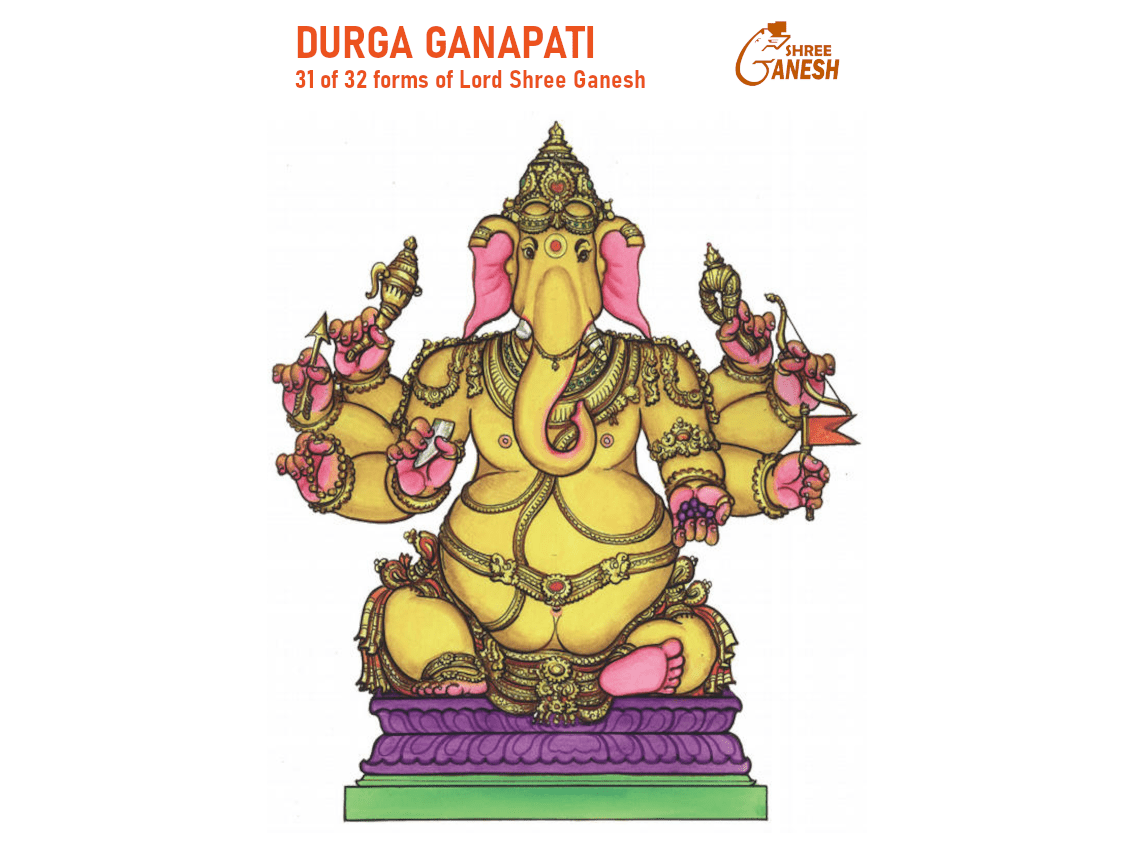
Durga Ganapati (दुर्गा गणपति) is the 31st of the 32 forms of Lord Ganesha. He is “the Invincible,” who waves the flag of victory over darkness. His form is of deep gold hue and dressed in red, holding a bow and arrow, a noose and goad, prayer beads, his broken tusk and a rose apple.
The 32 forms are listed in the Mudgala Purana, and their meditation verses and paintings are preserved in the Sritattvanidhi, a nineteenth-century treatise from the court of Mysore. This article looks at how Durga Ganapati is described there, and what his form means.
The Name Durga
His name recalls the goddess Durga, the fierce and invincible form of the Divine Mother, who rides a lion and defeats the buffalo demon Mahishasura. Ganesha is her son, the child of Parvati, and in this form he shares her power to overcome.
The word durga itself means a fort or stronghold, a place that is hard to reach and harder to take. Durga Ganapati is the Lord who conquers what seems unconquerable: the obstacles that stand like fortress walls between a devotee and their goal.
The Form of Durga Ganapati
Gold and red
His meditation verse describes him as taptakāñcana, like molten gold, with a mighty body (mahattanu), dressed in red. Gold is the colour of divinity and splendour; red is the colour of energy and action. Together they give the image of a strong, radiant Lord ready to act.
The flag of victory
In the paintings of this form he raises a red flag, the flag of victory over darkness. It is the sign of a battle won: the triumph of light over ignorance and of the devotee over the obstacles in their path.
Eight Arms and What They Hold
In his right hands:
- A shining goad (ankusha), to spur the devotee onward.
- An arrow (shara), for aim and focus, the mind sent straight to its goal.
- A rosary (akshamala), for japa: victory in this form begins with prayer.
- His broken tusk (danta), the sign of sacrifice. Ganesha gave up part of himself, and in his stories he broke off his tusk to use as a pen.
In his left hands:
- A noose (pasha), to hold back what would pull the devotee away.
- A bow (karmuka), paired with the arrow: the strength that gives the arrow its flight.
- A creeper (lata), a sign of growth and abundance.
- A rose apple (jambu), the fruit of the jambu tree, which gives its name to Jambudvipa, the ancient name for the land of India.
The Meditation Verse
The Sritattvanidhi gives this dhyana shloka for Durga Ganapati:
तप्तकाञ्चनसंकाशश्चाष्टहस्तो महत्तनुः ।
दीप्ताङ्कुशं शरं चाक्षं दन्तं दक्षे वहन् करैः ॥
वामे पाशं कार्मुकं च लतां जम्बू दधत्करैः ।
रक्तांशुकः सदा भूयाद् दुर्गागणपतिर्मुदे ॥
taptakāñcanasaṃkāśaś cāṣṭahasto mahattanuḥ / dīptāṅkuśaṃ śaraṃ cākṣaṃ dantaṃ dakṣe vahan karaiḥ // vāme pāśaṃ kārmukaṃ ca latāṃ jambū dadhat karaiḥ / raktāṃśukaḥ sadā bhūyād durgāgaṇapatir mude
In English: “Shining like molten gold, eight-armed and of mighty frame, bearing in his right hands a blazing goad, an arrow, a rosary and his tusk, and in his left a noose, a bow, a creeper and a rose apple, clad in red: may Durga Ganapati always bring us joy.”
The Significance of Durga Ganapati
Devotees turn to Durga Ganapati for victory, and for the removal of obstacles that seem too strong to overcome. His bow and arrow stand for focus and effort, his goad and noose for guidance and restraint, his beads for prayer. The fortress his name speaks of can also be read inwardly, as the body and senses, which the devotee learns to master.
The 32 forms, Durga Ganapati among them, are carved in stone at the Srikanteshvara temple in Nanjangud and the Chamarajeshvara temple in Chamarajanagar, both in Karnataka, and in the Pazhavangadi Ganapathy temple in Thiruvananthapuram, Kerala.
Conclusion
Durga Ganapati, golden and robed in red, raises the flag of victory over darkness. Sharing the name and power of the invincible goddess, he takes the fortress that seemed impossible to take, and the verse that describes him ends not with battle but with joy: sadā bhūyād mude, “may he always bring us joy.”
Frequently asked questions
- Who is Durga Ganapati?
Durga Ganapati (दुर्गा गणपति) is the 31st of the 32 forms of Lord Ganesha, “the Invincible,” who waves the flag of victory over darkness.
- What does Durga mean in his name?
It recalls the goddess Durga, the invincible; the word durga also means a fort or stronghold, something hard to reach or overcome.
- What does Durga Ganapati hold?
In his right hands a shining goad, an arrow, a rosary and his tusk; in his left a noose, a bow, a creeper and a rose apple.
- What colour is Durga Ganapati?
He is deep gold, like molten gold, with a mighty body, and is dressed in red.
- Why do devotees worship Durga Ganapati?
For victory and for the removal of obstacles that seem impossible to overcome; his verse asks him to bring us joy always.
Continue reading
About Lord Ganesha →
About Lord Ganesha
Pray to Lord Ganesha Online
About Lord Ganesha
Sankatahara Ganapati: The Dispeller of Sorrow
About Lord Ganesha