
Sankatahara Ganapati: The Dispeller of Sorrow
On this page
Introduction
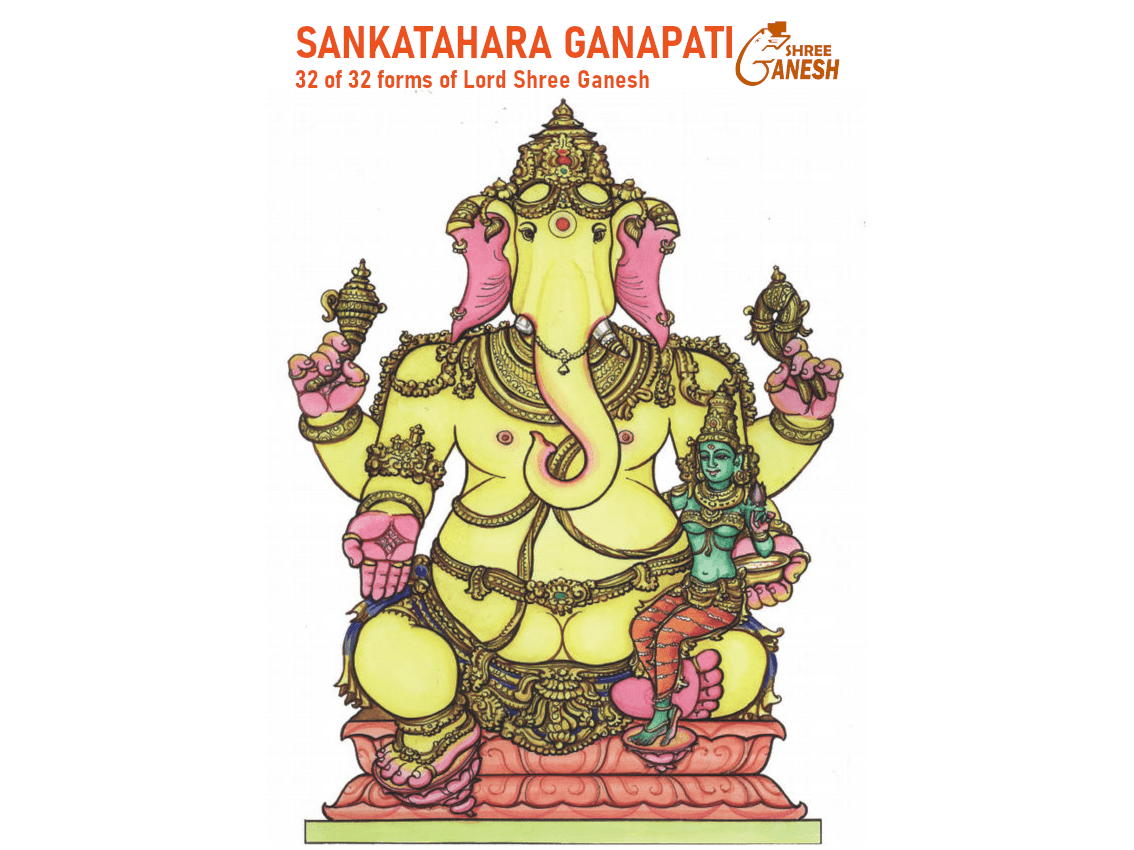
Sankatahara Ganapati (सङ्कटहर गणपति) is the 32nd and last of the 32 forms of Lord Ganesha. He is “the Dispeller of Sorrow,” of sunlike hue, dressed in blue and seated on a red lotus flower. He holds a bowl of pudding, a goad and a noose while gesturing the boon-granting varada mudra.
His name joins sankata, trouble, crisis or distress, with hara, the one who takes it away. Of all Ganesha’s forms, this one carries most directly the meaning that devotees everywhere know him for: the Lord who removes obstacles and sorrows.
The 32 forms are listed in the Mudgala Purana, and their meditation verses and paintings are preserved in the Sritattvanidhi, a nineteenth-century treatise from the court of Mysore.
The Form of Sankatahara Ganapati
Red as the young sun, dressed in blue
His meditation verse describes him as red like the young sun of morning, bālārka, and shining in blue garments. He sits on a red lotus, the flower of purity rising clean out of muddy water.
His shakti
On his left knee sits his shakti, his divine power in female form. The verse describes her as youthful, fair-limbed and adorned with jewels, holding a blue lotus (indivara) in her hand. Her presence shows that Ganesha’s power to remove sorrow is never apart from grace and gentleness.
Four Hands and What They Hold
- A goad (ankusha), in a right hand, to drive away trouble and spur the devotee on.
- The boon-granting gesture (varada mudra), with the other right hand, giving what the devotee prays for.
- A noose (pasha), in a left hand, to hold the devotee close and keep harm away.
- A bowl of payasam, a sweet milk pudding, in the other left hand: the sweetness that follows when sorrow is gone.
The Meditation Verse
The Sritattvanidhi gives this dhyana shloka for Sankatahara Ganapati:
बालार्कारुणकान्तिर्वामे बालां वहन्नङ्के
लसदिन्दीवरहस्तां गौराङ्गीं रत्नशोभाढ्याम् ।
दक्षेऽङ्कुशवरदानं वामे पाशं च पायसं पात्रम्
नीलांशुकलसमानः पीठे पद्मारुणे तिष्ठन् ।
सङ्कटहरणः पायात् सङ्कटपूगाद्गजाननो नित्यम् ॥
bālārkāruṇakāntir vāme bālāṃ vahann aṅke / lasad-indīvara-hastāṃ gaurāṅgīṃ ratnaśobhāḍhyām / dakṣe ’ṅkuśa-varadānaṃ vāme pāśaṃ ca pāyasaṃ pātram / nīlāṃśuka-lasamānaḥ pīṭhe padmāruṇe tiṣṭhan / saṅkaṭaharaṇaḥ pāyāt saṅkaṭapūgād gajānano nityam
In English: “Red as the young sun, bearing on his left knee his youthful consort, fair and jewelled, a blue lotus shining in her hand; with goad and boon-giving gesture on the right, noose and a bowl of payasam on the left; shining in blue, seated on a red lotus: may the elephant-faced Remover of Distress ever protect us from our many troubles.”
Sankashti Chaturthi
The name of this form is shared by one of the most widely kept Ganesha observances: Sankashti Chaturthi, called Sankatahara Chaturthi in South India.
It falls every month on chaturthi, the fourth day of the waning moon. Devotees fast from morning until the moon rises, pray to Ganesha, and break the fast after sighting the moon and offering it water. Many recite the Ganapati Atharvashirsha before moonrise. When the day falls on a Tuesday it is called Angaraki Chaturthi, after Angaraka, the planet Mars, and is held to be especially auspicious.
The fast is kept to remove troubles from the devotee’s life, which is exactly what Sankatahara means.
The Sankatanashana Ganesha Stotra
A hymn often recited on this day is the Sankatanashana Ganesha Stotra, “the hymn that destroys distress,” attributed to the Narada Purana. It begins praṇamya śirasā devaṃ gaurīputraṃ vināyakam, “bowing my head to the god Vinayaka, son of Gauri,” and gives twelve names of Ganesha: Vakratunda, Ekadanta, Krishnapingaksha, Gajavaktra, Lambodara, Vikata, Vighnaraja, Dhumravarna, Bhalachandra, Vinayaka, Ganapati and Gajanana. Reciting them at dawn, noon and dusk is said to remove all fear of obstacles.
The Significance of Sankatahara Ganapati
Devotees turn to Sankatahara Ganapati to remove troubles and sorrow, for protection, and for happiness. His verse ends with a prayer that speaks for everyone who has faced hard times: saṅkaṭapūgāt pāyāt, “may he protect us from our heaps of troubles,” and nityam, “always.”
The 32 forms, Sankatahara Ganapati among them, are carved in stone at the Srikanteshvara temple in Nanjangud and the Chamarajeshvara temple in Chamarajanagar, both in Karnataka, and in the Pazhavangadi Ganapathy temple in Thiruvananthapuram, Kerala.
Conclusion
Sankatahara Ganapati, last of the 32 forms, gathers up what all of them teach. Red as the dawn, seated on a red lotus with his shakti beside him, he holds out a bowl of sweet pudding to those who come to him in distress. Every month, on Sankashti Chaturthi, devotees fast and wait for the moon to rise, praying to him to take their troubles away.
Frequently asked questions
- Who is Sankatahara Ganapati?
Sankatahara Ganapati (सङ्कटहर गणपति) is the 32nd and last of the 32 forms of Lord Ganesha, “the Dispeller of Sorrow,” of sunlike hue, dressed in blue and seated on a red lotus.
- What does Sankatahara mean?
Sankata means trouble, crisis or distress, and hara means the one who takes it away: the remover of distress.
- What does Sankatahara Ganapati hold?
He holds a goad, a noose and a bowl of payasam, a sweet milk pudding, and makes the boon-granting varada mudra; his shakti sits on his left knee holding a blue lotus.
- What is Sankashti Chaturthi?
A monthly fast to Ganesha on the fourth day of the waning moon, kept from morning until moonrise; in South India it is also called Sankatahara Chaturthi, sharing this form’s name.
- What is Angaraki Chaturthi?
When Sankashti Chaturthi falls on a Tuesday it is called Angaraki Chaturthi and is held to be especially auspicious.
- Why do devotees worship Sankatahara Ganapati?
To remove troubles and sorrow, for protection, and for happiness; his verse asks him to protect us always from our many troubles.
Continue reading
About Lord Ganesha →
About Lord Ganesha
Pray to Lord Ganesha Online
About Lord Ganesha
Durga Ganapati: The Invincible
About Lord Ganesha