
Bala Ganapati: The Divine Child of Golden Radiance
On this page
Introduction
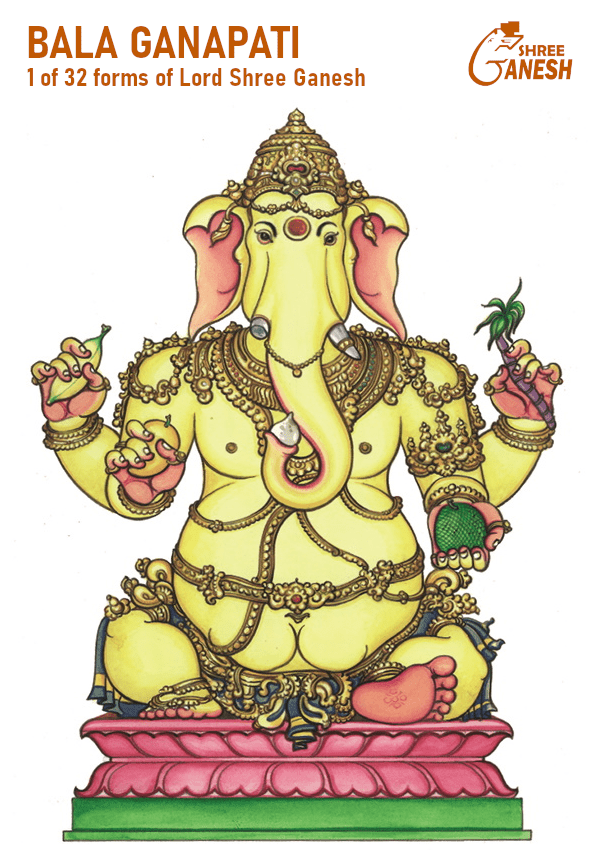
Bala Ganapati (बाल गणपति) is the first of the 32 forms of Lord Ganesha. Bala Ganapati is “the Childlike” God of golden hue. In his hands he holds a banana, a mango, sugarcane and a jackfruit, all signs of the earth’s abundance and fertility, and his trunk curls around his favourite sweet, the modaka.
Bala means “child.” This is Ganesha as a little boy: plump, happy and bright, the form in which he is easiest to love. Because he stands first in the list, he is also the form with which the whole series of 32 begins.
The 32 forms are listed in the Mudgala Purana, and their meditation verses and paintings are preserved in the Sritattvanidhi, a nineteenth-century treatise from the court of Mysore.
The Form of Bala Ganapati
A child
Bala Ganapati is shown as a small boy with a round belly and an elephant face, seated and at ease. He has four arms. There are no weapons in any of his hands: nothing to fight with, only fruit and sweets. A child does not need to conquer anything to be loved, and Bala Ganapati asks nothing of his devotees except the same simple affection.
The colour of the rising sun
His meditation verse calls him bālasūryanibha, “like the young sun,” the sun just risen over the horizon. Sources describe that colour in two ways. The popular description of the 32 forms calls him golden, and the morning sun is often painted that way. The Sritattvanidhi, which records a colour for each form, marks him as red, the deeper red-gold of dawn. Both point to the same picture: the gentle light of early morning, warm rather than fierce, at the start of a new day.
Four Arms and What They Hold
- A banana (kadali), the fruit offered in almost every puja, a sign of plenty.
- A mango (chuta), the sweetest of Indian fruits.
- A jackfruit (panasa), the largest of fruits, rough outside and sweet within.
- A stalk of sugarcane (ikshu), the source of sweetness itself.
- A modaka, the sweet dumpling that is Ganesha’s favourite food, held in his trunk.
The verse lists the modaka with the things “held in his hands,” and some pictures do place it in a hand; in the familiar image, his four hands hold the fruits and his trunk holds the sweet. Together they show the generous earth, which gives food to everyone, and the sweetness of a life lived close to the divine.
The Meditation Verse
The Sritattvanidhi gives this dhyana shloka for Bala Ganapati:
करस्थकदलीचूतपनसेक्षुकमोदकम् ।
बालसूर्यनिभं वन्दे देवं बालगणाधिपम् ॥
karastha-kadalī-cūta-panasekṣuka-modakam / bālasūrya-nibhaṃ vande devaṃ bāla-gaṇādhipam
In English: “I bow to the god Bala Ganadhipa, the child Lord of the ganas, bright as the rising sun, who holds in his hands a banana, a mango, a jackfruit, sugarcane and a modaka.”
Ganesha as a Child in Hindu Tradition
Many of the best-loved stories of Ganesha are stories of his childhood: how Parvati made him and set him to guard her door, how he came to have an elephant’s head, and how he won the race around the world by walking around his parents. You can read them in the story of Lord Ganesha and Ganesh and Kartik’s race around the world. In the race, the prize was a fruit, and Ganesha won it not by speed but by love for his parents. Bala Ganapati, holding his fruits, is the child of these stories.
The Significance of Bala Ganapati
Bala Ganapati reminds devotees that the divine can be loved as simply as a child is loved. Parents pray to him for their children, and devotees turn to him for a good beginning, for plenty in the home, and for the trusting, open heart of a child. His fruits are the gifts of the earth, given freely; his modaka is the sweetness of devotion.
He is the first of the sixteen forms, the Shodasha Ganapati. As Loving Ganesha records, these sixteen are installed in an eight-sided, chariot-shaped shrine at the Shri Shankara Mandapam in Rameshvaram, South India, established by Shri Chandrasekharendra Saraswati, the 68th head of the Kanchi Kamakoti Pitham.
The 32 forms, Bala Ganapati among them, are carved in stone at the Srikanteshvara temple in Nanjangud and the Chamarajeshvara temple in Chamarajanagar, both in Karnataka, and in the Pazhavangadi Ganapathy temple in Thiruvananthapuram, Kerala.
Conclusion
Bala Ganapati, the Childlike, shines like the morning sun, his hands full of banana, mango, jackfruit and sugarcane, a modaka in his trunk. He carries no weapon and asks for nothing but love. At the start of the 32 forms, he stands for every good beginning, and for the joy of a heart that trusts like a child.
Frequently asked questions
- Who is Bala Ganapati?
Bala Ganapati (बाल गणपति) is the first of the 32 forms of Lord Ganesha, “the Childlike,” Ganesha as a young child.
- What does Bala mean?
Bala means “child” in Sanskrit. Bala Ganapati is Ganesha as a little boy, the Lord of the ganas seen through the eyes of love for a child.
- What does Bala Ganapati hold?
A banana, a mango, a jackfruit and a stalk of sugarcane, all signs of the earth’s abundance, along with his favourite sweet, the modaka.
- What colour is Bala Ganapati?
His meditation verse says he shines like the rising sun. Some describe him as golden, others as red: the soft red-gold of the morning sun.
- What is the meditation verse of Bala Ganapati?
It begins “karastha kadalī-cūta” and means: “I bow to the god Bala Ganadhipa, bright as the rising sun, who holds in his hands a banana, a mango, a jackfruit, sugarcane and a modaka.”
- Why do devotees worship Bala Ganapati?
Devotees turn to him for the simple, trusting love of a child, for a good beginning, and for the blessing of plenty in the home.
Continue reading
About Lord Ganesha →
About Lord Ganesha
Pray to Lord Ganesha Online
About Lord Ganesha
Sankatahara Ganapati: The Dispeller of Sorrow
About Lord Ganesha