
Bhakti Ganapati: The God of Devotion and Divine Offerings
On this page
Introduction
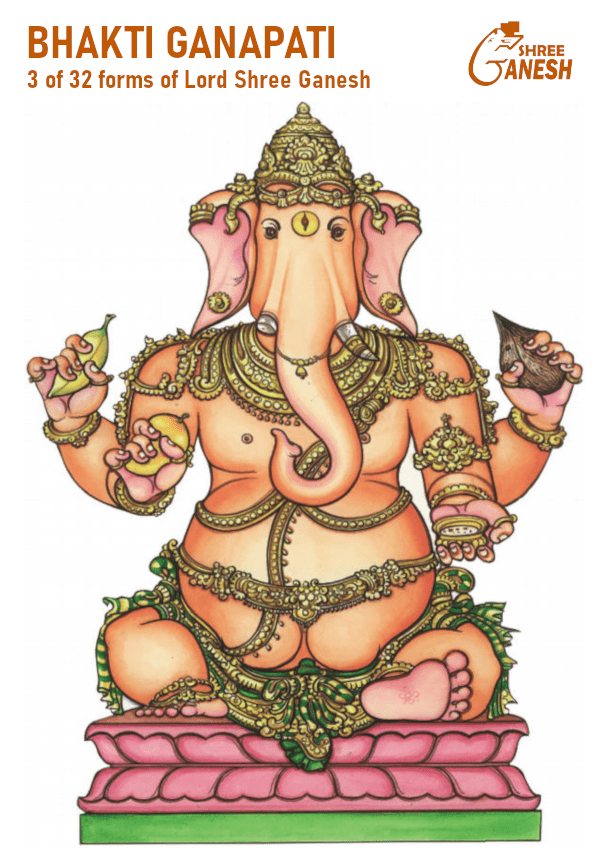
Bhakti Ganapati (भक्ति गणपति) is the third of the 32 forms of Lord Ganesha. Shining like the full moon of the harvest season and garlanded with flowers, Bhakti Ganapati, dear to devotees, is pleasant to look upon. He holds a banana, a mango, a coconut and a bowl of sweet payasa pudding.
Bhakti means loving devotion. His meditation verse calls him Bhakta-gaṇādhipa, and the Sritattvanidhi names the form Bhakta Ganapati: the Lord of the ganas who belongs to his devotees. Both names say the same thing. This is Ganesha as the devotee meets him in worship, holding the very offerings that are placed before him.
The 32 forms are listed in the Mudgala Purana, and their meditation verses and paintings are preserved in the Sritattvanidhi, a nineteenth-century treatise from the court of Mysore.
The Form of Bhakti Ganapati
White as the autumn moon
His meditation verse says his body shines like the śarac-candra, the moon of autumn, and the Sritattvanidhi marks his colour as white. Autumn, after the monsoon rains, is the harvest season of India, when the air is clear and the full moon is at its brightest. White is the colour of purity and calm, and the cool light of the moon is gentle where the sun is fierce. Bhakti Ganapati’s face is peaceful, and his look is kind.
The garland of flowers
He is usually shown garlanded with fresh flowers. The verse itself does not mention the garland, but flowers are the first and simplest of all offerings, and a garland on the deity is the sign that worship has been received.
Four Arms and What They Hold
Bhakti Ganapati has four arms, and each holds an offering of puja:
- A coconut (narikela), offered and broken before the deity. Its hard shell is the ego; once it is broken, the pure white flesh and sweet water inside can be offered.
- A mango (amra), the sweetest of fruits, for the sweetness of a life given to God.
- A banana (kadali), the fruit offered in nearly every puja, a sign of plenty.
- A bowl of payasa, rice pudding sweetened with guda, jaggery, the kind of sweet food made at home and brought to the temple.
The Meditation Verse
The Sritattvanidhi gives this dhyana shloka for Bhakti Ganapati:
नारिकेलाम्रकदलीगुडपायसधारिणम् ।
शरच्चन्द्राभवपुषं भजे भक्तगणाधिपम् ॥
nārikelāmra-kadalī-guḍa-pāyasa-dhāriṇam / śaraccandrābha-vapuṣaṃ bhaje bhakta-gaṇādhipam
In English: “I worship the Lord of the ganas who is dear to his devotees, whose body shines like the autumn moon, and who holds a coconut, a mango, a banana and pudding sweetened with jaggery.”
Offerings Returned
Bhakti Ganapati holds what devotees bring to him. The coconut, the fruits and the sweet pudding are the common offerings of a Ganesha puja, and after worship they come back to the devotee as prasada, food blessed by the deity. In this form, the offering and the blessing are the same thing: what is given in love is received, made holy, and given back.
The verse uses the word bhaje, “I worship” or “I love and serve,” from the same root as bhakti. It asks for nothing in return. Devotion here is its own reward.
The Significance of Bhakti Ganapati
Bhakti Ganapati is the form of Ganesha closest to the devotee’s own worship. Devotees turn to him to deepen their devotion, to learn to offer themselves along with their gifts, and to find peace in the act of worship itself. His coconut asks them to break the shell of ego; his fruits and sweets show that the simplest offering, given with love, is enough.
He is one of the first sixteen forms, the Shodasha Ganapati. As Loving Ganesha records, these sixteen are installed in an eight-sided, chariot-shaped shrine at the Shri Shankara Mandapam in Rameshvaram, South India, established by Shri Chandrasekharendra Saraswati, the 68th head of the Kanchi Kamakoti Pitham. You can pray to Ganesha yourself in the online prayer.
The 32 forms, Bhakti Ganapati among them, are carved in stone at the Srikanteshvara temple in Nanjangud and the Chamarajeshvara temple in Chamarajanagar, both in Karnataka, and in the Pazhavangadi Ganapathy temple in Thiruvananthapuram, Kerala.
Conclusion
Bhakti Ganapati, dear to devotees, shines white as the autumn moon, garlanded with flowers and holding a coconut, a mango, a banana and a bowl of sweet payasa. He holds the offerings of his worshippers and returns them as blessings. He is Ganesha as love meets him: calm, kind and close at hand.
Frequently asked questions
- Who is Bhakti Ganapati?
Bhakti Ganapati (भक्ति गणपति) is the third of the 32 forms of Lord Ganesha, the Lord dear to his devotees, who shines like the full moon of autumn.
- What does Bhakti mean?
Bhakti means loving devotion. His meditation verse calls him Bhakta Ganadhipa, the Lord of the ganas who belongs to his devotees.
- What does Bhakti Ganapati hold?
A banana, a mango, a coconut and a bowl of sweet payasa pudding made with jaggery: the very things devotees offer in puja.
- What colour is Bhakti Ganapati?
White. His meditation verse says his body shines like the autumn moon, and the Sritattvanidhi marks his colour as white.
- What is the meaning of the coconut Bhakti Ganapati holds?
The coconut, broken before the deity in worship, stands for the breaking of the hard shell of ego so that the pure, sweet heart inside can be offered.
- Why do devotees worship Bhakti Ganapati?
He is the form of Ganesha closest to the devotee’s own worship. Devotees turn to him to deepen their devotion and to offer themselves along with their gifts.
Continue reading
About Lord Ganesha →
About Lord Ganesha
Pray to Lord Ganesha Online
About Lord Ganesha
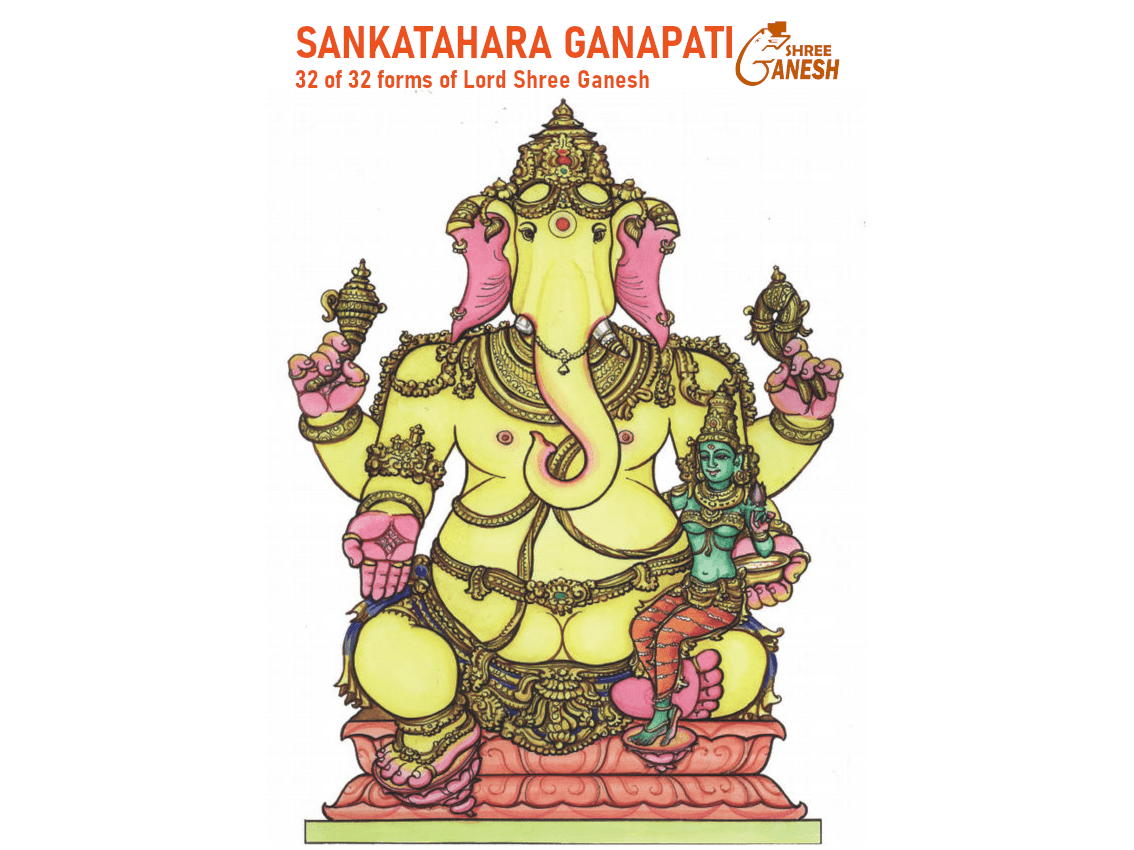
Sankatahara Ganapati: The Dispeller of Sorrow
About Lord Ganesha