
Dhundhi Ganapati: The Sought After
On this page
Introduction
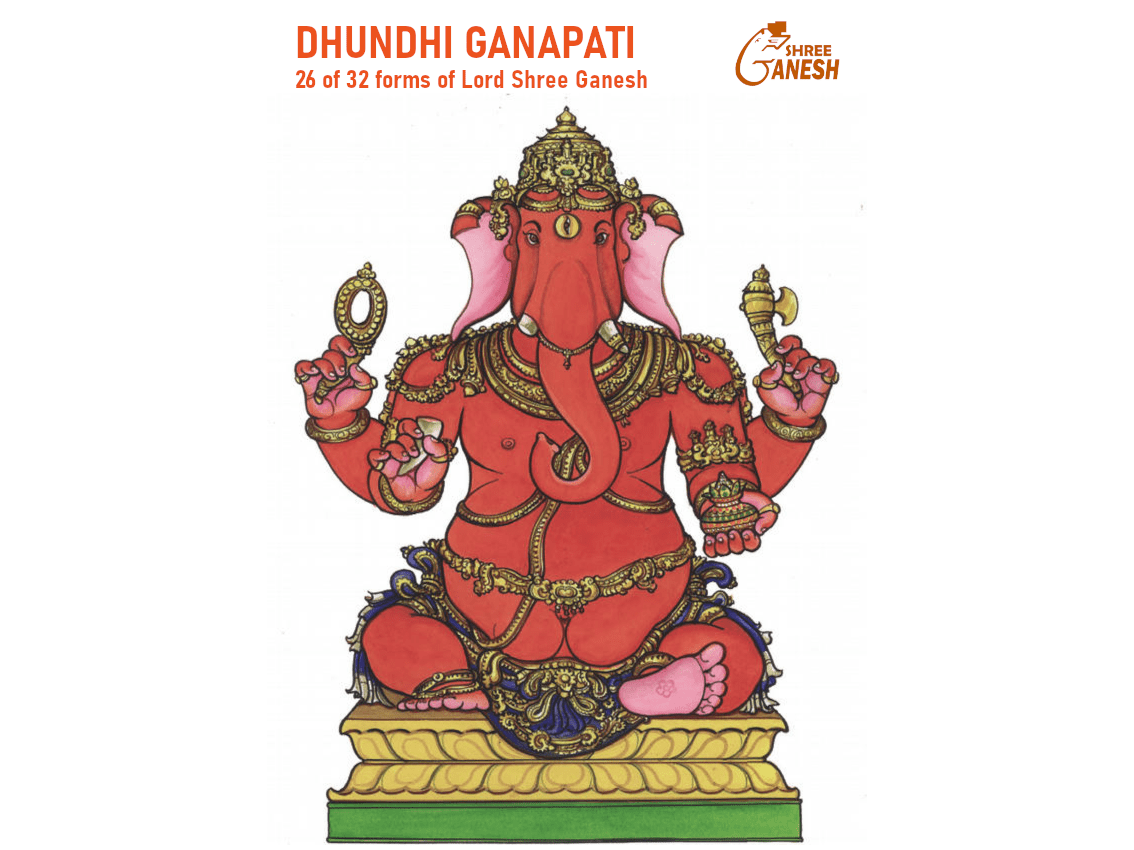
Dhundhi Ganapati (ढुण्ढि गणपति) is the 26th of the 32 forms of Lord Ganesha. Red-hued Dhundhi Ganapati, “the Sought After,” holds a strand of rudraksha beads, his broken tusk, an axe and a small pot of precious gems, thought to represent the treasury of awakenings he saves for all ardent devotees.
His name comes from the Sanskrit root ḍhuṇḍh, to search or seek. He is the one whom devotees seek, and the one who searches out what they long for in order to give it. Under the name Dhundhiraj, he is the chief Ganesha of Kashi, the holy city of Varanasi.
The 32 forms are listed in the Mudgala Purana, and their meditation verses and paintings are preserved in the Sritattvanidhi, a nineteenth-century treatise from the court of Mysore.
The Form of Dhundhi Ganapati
His colour is red, the colour of energy and action. His four hands hold:
- A strand of rudraksha beads (akshamala), the seeds sacred to Shiva, for prayer and japa.
- An axe (kuthara), to cut through ignorance and attachment.
- A small pot of precious gems (ratnapatra), the treasury of awakenings that he keeps for those who seek him sincerely.
- His own broken tusk (svadanta), the sign of sacrifice.
The Meditation Verse
अक्षमालां कुठारं च रत्नपात्रं स्वदन्तकम् ।
धत्ते करैर्विघ्नराजो ढुण्ढिनामा मुदेऽस्तु नः ॥
akṣamālāṃ kuṭhāraṃ ca ratnapātraṃ svadantakam / dhatte karair vighnarājo ḍhuṇḍhi-nāmā mude ’stu naḥ
In English: “The King of Obstacles named Dhundhi, who holds in his hands a rosary, an axe, a pot of gems and his own tusk: may he bring us joy.”
Dhundhiraj Vinayaka of Kashi
In Varanasi, Dhundhiraj Vinayaka has a small shrine in the lane leading to the Kashi Vishwanath temple, the great temple of Shiva. Pilgrims worship Dhundhiraj first, before they go on to Vishwanath, as Ganesha is worshipped before every undertaking.
The Kashi Khanda of the Skanda Purana describes 56 Vinayakas, forms of Ganesha set in seven rings of eight around the sacred city to guard it. Dhundhiraj is at their centre. One of them, Uddanda Vinayaka, shares his name with Uddanda Ganapati, the 24th of the 32 forms.
How Ganesha became Dhundhi
The Kashi Khanda tells how Ganesha came to be called Dhundhi.
Kashi was once ruled by King Divodasa, who governed so righteously that even the gods could find no fault with him. He had won his kingdom on the condition that the gods stay away, and so Shiva himself had to leave his beloved city and live on Mount Mandara. Shiva longed to return, and sent one messenger after another to find a way, but none succeeded.
At last Shiva sent Ganesha. Ganesha went to Kashi disguised as an old astrologer. He gave the people of the city strange and troubling dreams at night, and in the morning, when they came to him, he read the dreams as warnings of what was to come. Slowly the city was unsettled, and the way was prepared for Divodasa to give up his throne. Shiva was then able to return to Kashi.
Shiva praised Ganesha for what he had done, and named him Dhundhi, “the one who searches,” because he searches out everything his devotees need. The Kashi Khanda adds that no one can enter Kashi, or win its blessings, without first pleasing Dhundhi.
Dhundhiraja Chaturthi
The fourth day of the bright half of the month of Phalguna is kept as Dhundhiraja Chaturthi, a day of special worship to Ganesha in this form.
The Significance of Dhundhi Ganapati
Dhundhi Ganapati is the Lord to whom seekers turn. His rudraksha beads point to prayer, his axe to the cutting away of what blocks the way, and his pot of gems to the reward waiting for those who keep seeking. He is the one who is sought, and the one who, in turn, seeks out his devotees’ wishes to fulfil them.
The 32 forms, Dhundhi Ganapati among them, are carved in stone at the Srikanteshvara temple in Nanjangud and the Chamarajeshvara temple in Chamarajanagar, both in Karnataka, and in the Pazhavangadi Ganapathy temple in Thiruvananthapuram, Kerala.
Conclusion
Dhundhi Ganapati, red-hued and holding his treasury of gems, is the Sought After. In Kashi he stands at the gate of Shiva’s city, worshipped first by every pilgrim, as he once prepared the way for Shiva to come home. For every seeker, he keeps a treasury of awakenings.
Frequently asked questions
- Who is Dhundhi Ganapati?
Dhundhi Ganapati (ढुण्ढि गणपति) is the 26th of the 32 forms of Lord Ganesha, “the Sought After,” of red hue.
- What does Dhundhi mean?
It comes from the Sanskrit root ḍhuṇḍh, to search: he is the one devotees seek, and the one who searches out their wishes to fulfil them.
- What does Dhundhi Ganapati hold?
A strand of rudraksha beads, his broken tusk, an axe and a small pot of precious gems, thought to represent the treasury of awakenings he saves for ardent devotees.
- What is Dhundhiraj Vinayaka?
The chief Ganesha of Kashi (Varanasi), whose shrine stands in the lane leading to the Kashi Vishwanath temple; pilgrims worship him before Vishwanath.
- How did Ganesha get the name Dhundhi?
In the Skanda Purana’s Kashi Khanda, Shiva sent Ganesha to Kashi in disguise; when Ganesha’s work there was done and Shiva returned, Shiva praised him and named him Dhundhi.
Continue reading
About Lord Ganesha →
About Lord Ganesha
Pray to Lord Ganesha Online
About Lord Ganesha
Sankatahara Ganapati: The Dispeller of Sorrow
About Lord Ganesha