
Dvija Ganapati: The Divine Symbol of Disciplined Striving
On this page
Introduction
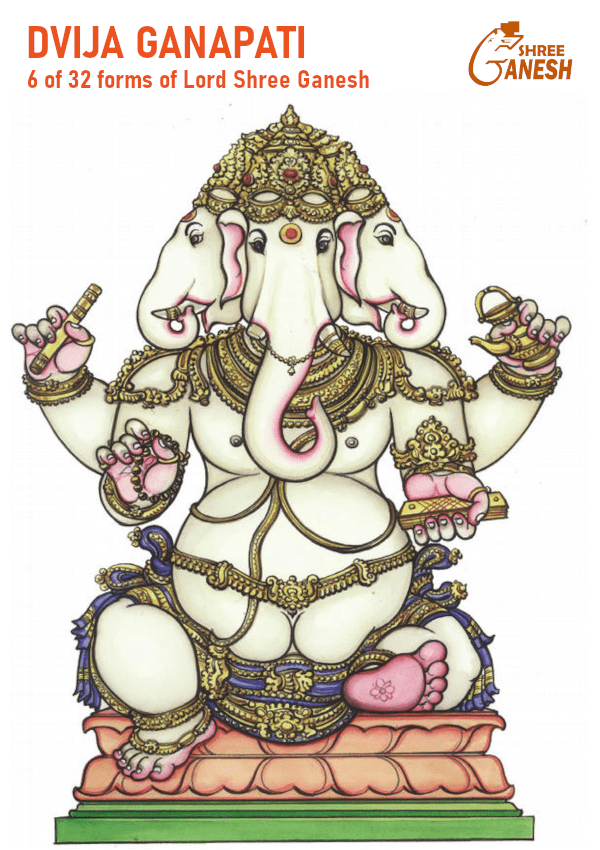
Dvija Ganapati (द्विज गणपति) is the 6th of the 32 forms of Lord Ganesha. Four-headed Dvija Ganapati, “the Twice-Born,” is moon-like in colour. Holding a palm-leaf scripture, a staff, a water vessel and his japa beads, he reminds one and all of the urgency of disciplined striving.
His name joins dvi, two, and ja, born. In Hindu tradition a boy is “born again” when he receives the sacred thread at the upanayana ceremony and begins the study of the Vedas, and from then on he is called dvija, twice-born. Dvija Ganapati carries the marks of that life of study: the book, the beads, the staff and the water pot of a Vedic student or an ascetic.
The 32 forms are listed in the Mudgala Purana, and their meditation verses and paintings are preserved in the Sritattvanidhi, a nineteenth-century treatise from the court of Mysore. This article looks at how Dvija Ganapati is described there, and what his form means.
The Form of Dvija Ganapati
Four elephant faces
Dvija Ganapati has four elephant faces. His meditation verse says he is stamberamānana-catuṣṭaya-śobhamāna, “resplendent with four elephant faces.” In this he resembles Brahma, the four-faced creator, who in Hindu tradition brought forth the four Vedas. The four faces are often read as those four Vedas, the Rig, Yajur, Sama and Atharva: the whole of sacred knowledge, looking out in every direction.
White as the moon
The verse calls him induvarṇa, moon-coloured. White is the colour of purity and calm. It suits a form who stands for the quiet, steady life of study and prayer.
Twice-born
The name is often read in two ways. It is the twice-born of the sacred thread, who is born first of his mother and then again into spiritual life. It is also read as a reminder of Ganesha’s own story: in Hindu mythology he was born of Parvati, lost his head to Shiva, and was given new life with the head of an elephant. You can read that story in The Birth of Lord Ganesha.
Four Arms and What They Hold
Dvija Ganapati has four arms. His meditation verse names what they hold:
- A book (pustaka), the ola or palm-leaf scripture of old India. It stands for sacred learning, and for the study of the Vedas that the twice-born takes up.
- A rosary (akshamala), the japa beads, often of rudraksha, for the repetition of a mantra and constant remembrance of the divine.
- A staff (danda), the plain staff carried by a student or a renunciate. It stands for discipline and self-control.
- A water pot (kamandalu), the vessel of the ascetic, for purity and simple living.
Some descriptions of this form, including older versions of this article, add a noose and a goad. The meditation verse in the Sritattvanidhi names only these four.
The Meditation Verse
The Sritattvanidhi gives this dhyana shloka for Dvija Ganapati:
यं पुस्तकाक्षगुणदण्डकमण्डलुश्रीविद्योतमानकरभूषणमिन्दुवर्णम् ।
स्तम्बेरमाननचतुष्टयशोभमानं त्वां यः स्मरेद् द्विजगणाधिपते स धन्यः ॥
yaṃ pustakākṣaguṇadaṇḍakamaṇḍaluśrīvidyotamānakarabhūṣaṇam induvarṇam / stamberamānanacatuṣṭayaśobhamānaṃ tvāṃ yaḥ smared dvijagaṇādhipate sa dhanyaḥ
In English: “O Dvija Ganapati, Lord of the ganas, blessed is the one who remembers you: moon-coloured, your hands adorned and shining with a book, a rosary, a staff and a water pot, and resplendent with four elephant faces.”
The Significance of Dvija Ganapati
The verse makes a simple promise: whoever remembers Dvija Ganapati is blessed, sa dhanyaḥ. Devotees turn to him for learning, for discipline, and for steadiness in their practice. He is also seen as the form of Ganesha who helps make a worldly life worthwhile, bringing knowledge and a good name to those who work with care.
His four objects describe a way of life more than a set of powers. The book asks for study, the beads for prayer, the staff for self-control and the water pot for simplicity. Together they are the disciplined striving that the overview of the 32 forms speaks of: spiritual life is not left for later, but taken up now and kept up every day.
He is one of the first sixteen forms, the Shodasha Ganapati. As Loving Ganesha records, these sixteen are installed in an eight-sided, chariot-shaped shrine at the Shri Shankara Mandapam in Rameshvaram, South India, established by Shri Chandrasekharendra Saraswati, the 68th head of the Kanchi Kamakoti Pitham.
The 32 forms, Dvija Ganapati among them, are carved in stone at the Srikanteshvara temple in Nanjangud and the Chamarajeshvara temple in Chamarajanagar, both in Karnataka, and in the Pazhavangadi Ganapathy temple in Thiruvananthapuram, Kerala.
Conclusion
Dvija Ganapati, four-faced and white as the moon, holds the book, beads, staff and water pot of the twice-born. Like Brahma he looks out with four faces over all sacred knowledge, and like a Vedic student he carries only what study and prayer need. He reminds his devotees that the spiritual life asks for discipline, and that the one who remembers him is blessed.
Frequently asked questions
- Who is Dvija Ganapati?
Dvija Ganapati (द्विज गणपति) is the 6th of the 32 forms of Lord Ganesha, “the Twice-Born,” with four faces and a colour like the moon.
- What does Dvija mean?
Dvija means “twice-born,” from dvi, two, and ja, born. It is the name for one who has been born a second time through the sacred-thread initiation, upanayana, and begun the study of the Vedas.
- What does Dvija Ganapati hold?
His meditation verse names four things: a book of palm-leaf scripture, a rosary, a staff and a water pot, the kamandalu.
- Why does Dvija Ganapati have four faces?
His four faces recall Brahma, the four-faced creator, and are often read as the four Vedas.
- Does Dvija Ganapati hold a noose and goad?
Some descriptions add a noose and goad, but the meditation verse in the Sritattvanidhi names only the book, rosary, staff and water pot.
- Why do devotees worship Dvija Ganapati?
Devotees turn to him for learning, discipline and steadiness in spiritual practice, and for a worldly life lived well.
Continue reading
About Lord Ganesha →
About Lord Ganesha
Pray to Lord Ganesha Online
About Lord Ganesha
Sankatahara Ganapati: The Dispeller of Sorrow
About Lord Ganesha