
Ekadanta Ganapati: The Lord of the Single Tusk
On this page
Introduction
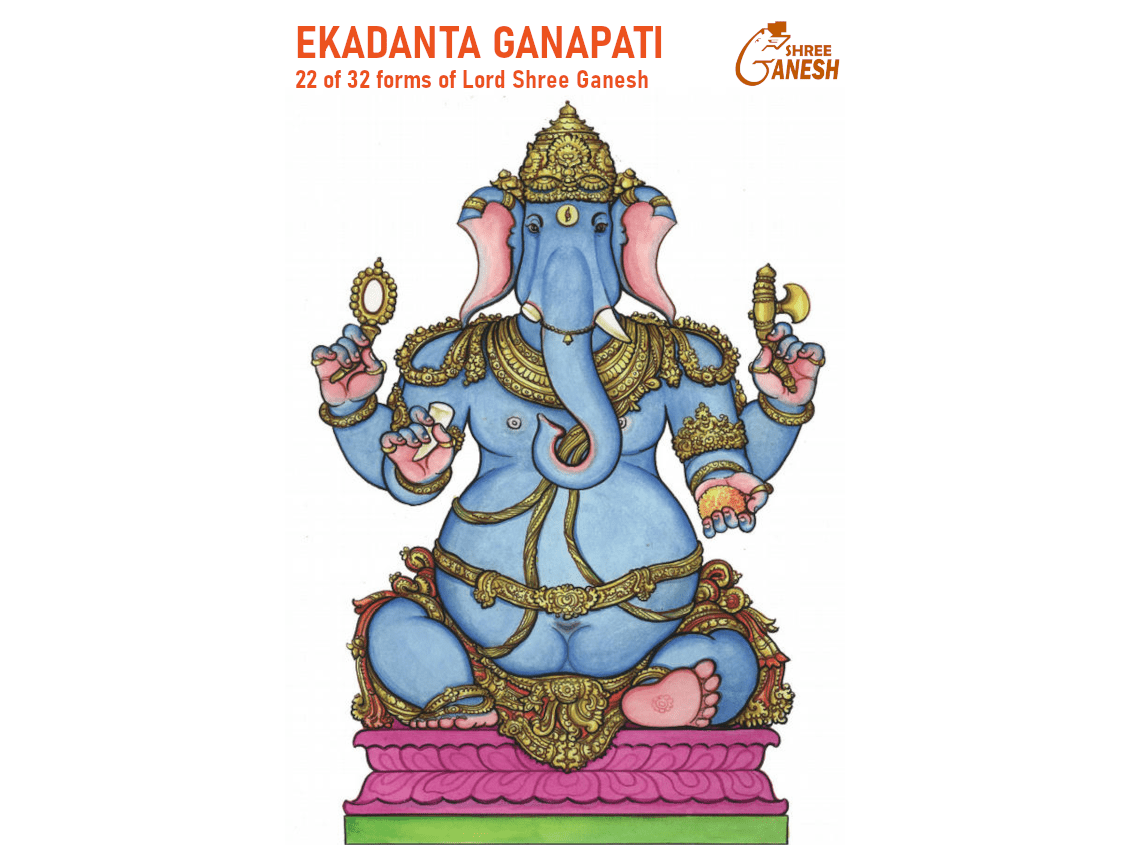
Ekadanta Ganapati (एकदन्त गणपति) is the 22nd of the 32 forms of Lord Ganesha. Ekadanta, of “Single Tusk,” is distinguished by his blue colour and sizeable belly. The attributes of this murti are an axe for cutting the bonds of ignorance, prayer beads for japa, a laddu sweet and the broken right tusk.
Ekadanta is one of Ganesha’s oldest and best-loved names. Some of the earliest images of Ganesha already show him holding his broken tusk, and the name is spoken every day in the Ganesh Gayatri and in the twelve names of the Sankatanashana Stotra.
The 32 forms are listed in the Mudgala Purana, and their meditation verses and paintings are preserved in the Sritattvanidhi, a nineteenth-century treatise from the court of Mysore.
The Form of Ekadanta Ganapati
Blue and dark
Ekadanta Ganapati is blue, and his meditation verse calls him śyāmatanu, dark-bodied. Dark blue is the colour of the sky and the deep ocean: of what is vast and without limit.
The great belly
His belly is large: the verse calls him Lambodara, “pot-bellied.” The universe itself is said to be held within Ganesha’s belly.
The single tusk
The single tusk is the heart of this form. Well-known stories tell how Ganesha lost one tusk. In one, he broke it off himself to use as a pen, so that he could keep writing the Mahabharata as the sage Vyasa recited it without stopping. In another, it was struck off in a fight with Parashurama, which is told in Ganesha and Parashurama. In a third, he broke it off and threw it at the moon, which had laughed at him, told in Lord Ganesha’s Broken Tusk. In the first two, the broken tusk stands for sacrifice: giving up part of oneself for a higher purpose.
Four Hands and What They Hold
His upper hands hold:
- An axe (kuthara), for cutting the bonds of ignorance and attachment.
- A rosary (akshamala), prayer beads for japa, the repetition of a mantra.
His lower hands hold:
- A laddu, a round sweet, for the sweetness of spiritual reward.
- His broken tusk, the sign of sacrifice that gives this form its name.
The Meditation Verse
लम्बोदरं श्यामतनुं गणेशं कुठारमक्षस्रजमूर्ध्वगाभ्याम् ।
सलड्डुकं दन्तमधःकराभ्यां वामेतराभ्यां च दधानमीडे ॥
lambodaraṃ śyāmatanuṃ gaṇeśaṃ kuṭhāram akṣasrajam ūrdhvagābhyām / salaḍḍukaṃ dantam adhaḥ-karābhyāṃ vāmetarābhyāṃ ca dadhānam īḍe
In English: “I praise Ganesha, pot-bellied and dark-bodied, holding an axe and a rosary in his upper hands, and a laddu and his tusk in his lower hands, left and right.”
Ekadanta, the Avatar Who Subdued Arrogance
The Mudgala Purana tells of eight avatars of Ganesha, each of whom overcomes a demon that stands for a human failing. Ekadanta is the second of them, and rides a mouse.
His opponent is Madasura, the demon of mada, arrogance and intoxication with power. Madasura gained great power through penance and came to rule the universe, and the gods, in distress, were told to pray to Ekadanta. Ekadanta came, and Madasura, faced with him, gave up and surrendered. In the Mudgala Purana the demon is not killed but subdued: arrogance is not destroyed but brought under control.
The Ekadanta Stotram, a hymn of praise to this avatar, comes from the same part of the Mudgala Purana.
Ekadanta in the Ganesh Gayatri
The name Ekadanta opens the Ganesh Gayatri Mantra, found in the Ganapati Atharvashirsha:
Om Ekadantāya vidmahe, Vakratuṇḍāya dhīmahi, tanno Dantiḥ pracodayāt.
“May we know the single-tusked one, may we meditate on the one with the curved trunk; may the tusked one inspire us.”
The Significance of Ekadanta Ganapati
Devotees turn to Ekadanta Ganapati to overcome scarcity and to see their work completed without obstacles. His axe cuts through ignorance, his beads keep the mind on prayer, and his single tusk reminds them that every real achievement asks for some sacrifice.
The 32 forms, Ekadanta Ganapati among them, are carved in stone at the Srikanteshvara temple in Nanjangud and the Chamarajeshvara temple in Chamarajanagar, both in Karnataka, and in the Pazhavangadi Ganapathy temple in Thiruvananthapuram, Kerala.
Conclusion
Ekadanta Ganapati, blue and great-bellied, holds the tusk that gives him his name. It is the tusk he gave up so that a great work could be written, and the name under which he subdued the demon of arrogance. With axe and beads, sweet and tusk, he teaches that wisdom is won by cutting through ignorance and giving of oneself.
Frequently asked questions
- Who is Ekadanta Ganapati?
Ekadanta Ganapati (एकदन्त गणपति) is the 22nd of the 32 forms of Lord Ganesha, “of Single Tusk,” distinguished by his blue colour and sizeable belly.
- What does Ekadanta mean?
Ekadanta means “the one with a single tusk,” from eka, one, and danta, tusk; it is one of Ganesha’s oldest names.
- What does Ekadanta Ganapati hold?
An axe for cutting the bonds of ignorance, prayer beads for japa, a laddu sweet and his broken right tusk.
- Who was Madasura?
In the Mudgala Purana, Madasura is the demon of arrogance; Ganesha’s avatar Ekadanta subdued him, and the demon surrendered.
- Where does Ekadanta appear in the Ganesh Gayatri?
The Ganesh Gayatri begins “Om Ekadantaya Vidmahe,” “may we know the single-tusked one.”
Continue reading
About Lord Ganesha →
About Lord Ganesha
Pray to Lord Ganesha Online
About Lord Ganesha
Sankatahara Ganapati: The Dispeller of Sorrow
About Lord Ganesha