
Ekakshara Ganapati: Single Syllable Power
On this page
Introduction
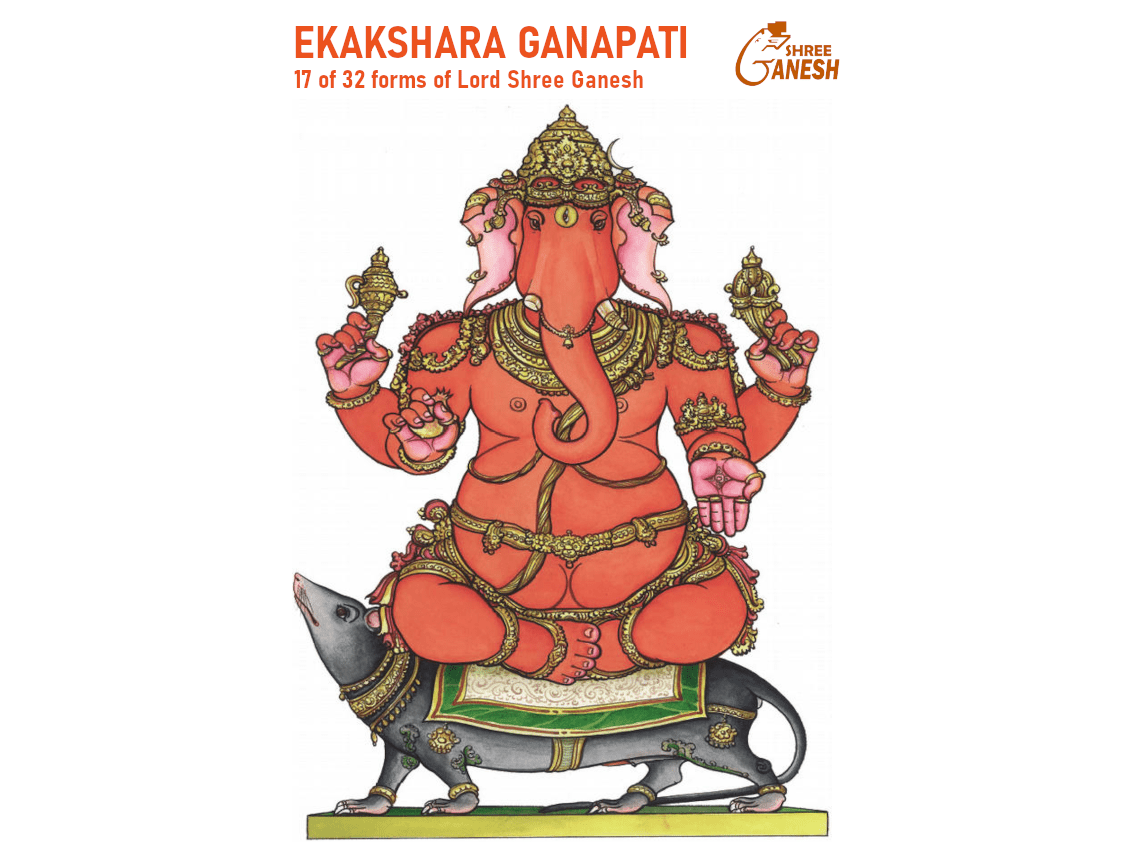
Ekakshara Ganapati (एकाक्षर गणपति) is the 17th of the 32 forms of Lord Ganesha. Ekakshara, of “Single Syllable,” is three-eyed and red in complexion and dress. With the crescent moon on his crown, he sits in lotus pose upon Mushika, his mouse, gives the boon-granting gesture, and holds a pomegranate, a noose and a goad.
His name comes from eka, one, and akṣara, syllable. The syllable is Gam (गं), the seed sound of Ganesha. Ekakshara Ganapati is the form of Ganesha that this one sound calls up.
The 32 forms are listed in the Mudgala Purana, and their meditation verses and paintings are preserved in the Sritattvanidhi, a nineteenth-century treatise from the court of Mysore.
The Form of Ekakshara Ganapati
Red all over
Ekakshara Ganapati is red, and so is everything about him. His meditation verse calls him “red, with red unguent, red garments and red flowers.” Red in Ganesha’s forms is the colour of energy, action and devotion, and the red flowers recall the hibiscus and other red blossoms offered to Ganesha in worship.
Three eyes and the crescent moon
He has three eyes and wears the crescent moon in his hair, candramauli. Both are marks of his father, Shiva. The third eye is the eye of wisdom that sees beyond the senses, and the crescent moon is the cool light that shines in darkness.
Short limbs and a great belly
The verse calls him tundila, big-bellied, and vāmana-kara-caraṇa, short in hand and foot: the sturdy, childlike body of the classic Ganesha image. He is ahibhūṣa, adorned with serpents, which also belong to Shiva and stand for energy held under control.
The lotus posture and the mouse
The verse seats him padmāsanastha, in the lotus posture, the cross-legged pose of meditation. The Mysore painting places him in that pose on the back of his mouse, Mushika. The mouse, who can slip into any place, shows that Ganesha reaches everywhere, and that even the smallest creature can carry the divine. You can read one telling of how the mouse came to him in Ganesha and the Mouse.
Four Hands and What They Hold
The verse lists five things for his four hands, so paintings and lists differ in what they leave out:
- A bijapura fruit (bijapura). The name means “full of seeds.” Strictly it is the citron, but it is usually painted and described as a pomegranate. Its many seeds stand for plenty and for the countless good things that grow from one source.
- A noose (pasha), which draws the devotee close and holds back what would pull them away.
- A goad (ankusha), which spurs the devotee on, as a mahout guides an elephant.
- His tusk (rada), the broken tusk, the sign of sacrifice.
- The boon-giving gesture (varada mudra), the hand turned down and open, granting the wishes of devotees.
The Mysore painting shows the fruit, the noose, the goad and the boon-giving hand, and leaves out the tusk. The art historian T. A. Gopinatha Rao lists the tusk, goad, noose and a modaka sweet.
The Meditation Verse
The Sritattvanidhi gives this dhyana shloka for Ekakshara Ganapati:
रक्तो रक्ताङ्गरागांशुककुसुमयुतस्तुन्दिलश्चन्द्रमौलिः
नेत्रैर्युक्तस्त्रिभिर्वामनकरचरणो बीजपूरं दधानः ।
हस्ताग्राक्लुप्तपाशाङ्कुशरदवरदो नागवक्त्रोऽहिभूषो
देवः पद्मासनस्थो भवतु सुखकरो भूतये विघ्नराजः ॥
rakto raktāṅgarāgāṃśuka-kusuma-yutas tundilaś candramauliḥ / netrair yuktas tribhir vāmana-kara-caraṇo bījapūraṃ dadhānaḥ / hastāgrāklupta-pāśāṅkuśa-rada-varado nāgavaktro ’hibhūṣo / devaḥ padmāsanastho bhavatu sukhakaro bhūtaye vighnarājaḥ
In English: “Red, with red unguent, red garments and red flowers, big-bellied, the moon on his crown, three-eyed, short in hand and foot, holding a bijapura fruit; with noose, goad and tusk in his hands and giving boons; elephant-faced, adorned with serpents, seated in the lotus posture: may the god, the King of Obstacles, bring us happiness and prosperity.”
Gam, the Single Syllable
Every deity in Hindu worship has a bija, a seed syllable that holds the whole power of the deity in one sound, as a seed holds a tree. Ganesha’s is Gam.
The Ganapati Atharvashirsha, the best-known Upanishad of Ganesha, teaches how the syllable is built: first the sound ga, then a, and last the anusvāra, the nasal hum. Together they make gaṃ, and with Om before it, Om Gam. It calls this the Gaṇeśa-vidyā, the sacred knowledge of Ganesha.
The seed syllable sits at the heart of Ganesha’s best-known mantras. It is the second word of Om Gam Ganapataye Namo Namah, and it appears in the Ganesh Mool Mantra. Ekakshara Ganapati is the form to hold in the mind while chanting it.
The Significance of Ekakshara Ganapati
The verse ends with a plain wish: bhavatu sukhakaro bhūtaye, “may he bring happiness and prosperity.” Devotees turn to Ekakshara Ganapati for exactly that, and especially those who chant his seed mantra. His form teaches that the divine does not need many words. One syllable, repeated with attention and love, is enough to reach him.
The 32 forms, Ekakshara Ganapati among them, are carved in stone at the Srikanteshvara temple in Nanjangud and the Chamarajeshvara temple in Chamarajanagar, both in Karnataka, and in the Pazhavangadi Ganapathy temple in Thiruvananthapuram, Kerala.
Conclusion
Ekakshara Ganapati, red from head to foot, sits in meditation with the moon in his hair and three eyes open to everything. With noose and goad he guides his devotees, with his tusk he teaches sacrifice, with his fruit he promises plenty, and with his open hand he gives boons. All of it is held in one sound: Gam.
Frequently asked questions
- Who is Ekakshara Ganapati?
Ekakshara Ganapati (एकाक्षर गणपति) is the 17th of the 32 forms of Lord Ganesha, the “Single-Syllable” Lord: three-eyed, red in complexion and dress, seated in lotus pose.
- What does Ekakshara mean?
Ekakshara means “single syllable,” from eka, one, and akshara, syllable. The syllable is Gam (गं), the seed sound of Ganesha.
- What is the mantra Gam?
Gam is Ganesha’s bija, or seed, mantra. The Ganapati Atharvashirsha teaches how it is formed: the sound G, then A, then the nasal hum of the anusvara.
- What does Ekakshara Ganapati hold?
His meditation verse names a bijapura fruit, a noose, a goad and his tusk, and he gives the boon-granting gesture. The fruit is usually shown as a pomegranate.
- How is Ekakshara Ganapati described?
He is red, with red garments, red unguent and red flowers; big-bellied, three-eyed, crowned with the crescent moon, adorned with serpents, and seated in the lotus posture.
- Why do devotees worship Ekakshara Ganapati?
His verse asks him to bring happiness and prosperity, and he is the form worshipped by those who chant his single-syllable mantra, Gam.
Continue reading
About Lord Ganesha →
About Lord Ganesha
Pray to Lord Ganesha Online
About Lord Ganesha
Sankatahara Ganapati: The Dispeller of Sorrow
About Lord Ganesha