
Lakshmi Ganapati: The Pure White Deity of Success
On this page
Introduction
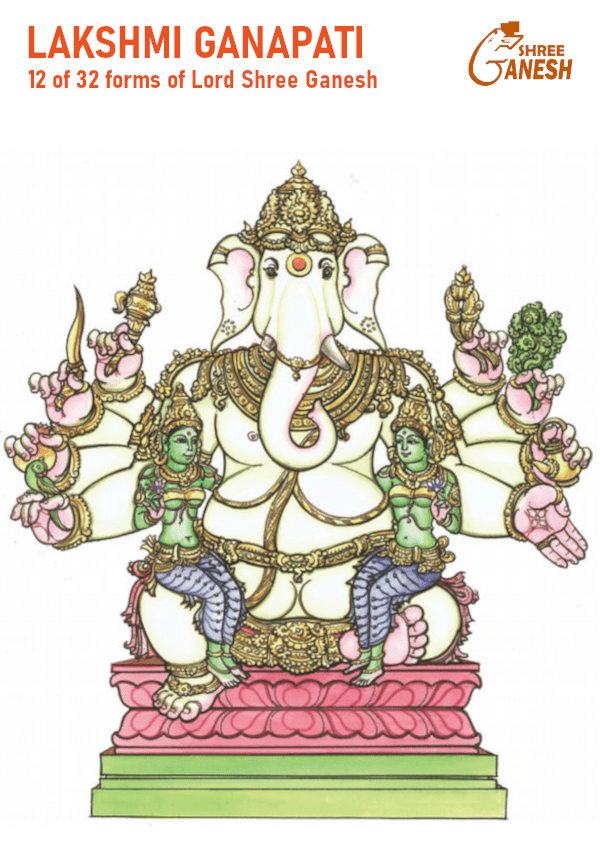
Lakshmi Ganapati (लक्ष्मी गणपति) is the 12th of the 32 forms of Lord Ganesha. Pure white and giver of success, he sits flanked by Wisdom and Achievement. With one hand he gives the boon-granting varada mudra, and in the others he holds a green parrot, a pomegranate, a sword, a goad, a noose, a sprig of the wish-fulfilling kalpavriksha and a pot of gems.
Lakshmi means good fortune, prosperity and beauty, and it is also the name of the goddess of wealth. Lakshmi Ganapati is Ganesha as the Lord of fortune and success, and his meditation verse calls him Lakṣmīgaṇeśa.
The 32 forms are listed in the Mudgala Purana, and their meditation verses and paintings are preserved in the Sritattvanidhi, a nineteenth-century treatise from the court of Mysore.
The Form of Lakshmi Ganapati
Pure white
His meditation verse calls him gaurāṅga, “fair-bodied,” and says he shines like a stream of nectar. White is the colour of purity, and it shows that the success he gives is clean: won rightly and used well.
Between Wisdom and Achievement
Two goddesses sit beside him. The verse calls them simply “the two goddesses,” and the overview of the 32 forms names them Wisdom and Achievement: Buddhi and Siddhi, who are known in Hindu tradition as Ganesha’s consorts. You can read how he came to marry them in Lord Ganesha’s Wedding with Siddhi and Buddhi. Their presence explains the form: lasting fortune comes with wisdom to guide it and the power to bring it to completion.
Not the Lakshmi and Ganesha of Diwali
Lakshmi Ganapati is a single form of Ganesha with his two consorts. He is different from the pairing of the goddess Lakshmi and Lord Ganesha, two deities side by side, who are worshipped together at Diwali.
Eight Arms and What They Hold
Lakshmi Ganapati has eight arms. Seven hold:
- A parrot (shuka), green in the paintings. The parrot is the bird of speech and of love, and stands for sweet and wise words.
- A citron or pomegranate (bijapura), the “seed-filled” fruit, for abundance and fertility. The Sanskrit word is often translated as pomegranate in writing on the 32 forms, though it more usually means a citron.
- A pot of gems (manikya kumbha), a vessel glittering with rubies, for wealth. The overview of the 32 forms calls it a water vessel, but the verse describes a pot of gems.
- A goad (ankusha), to spur the devotee onward.
- A noose (pasha), to draw the devotee close.
- A wish-fulfilling creeper (kalpalata), a sprig of the kalpavriksha, the tree that grants every wish.
- A sword (khadga), shining, to cut through obstacles.
The eighth hand gives:
- The boon-giving gesture (varada mudra), the open hand turned down, granting the wishes of devotees.
The Meditation Verse
The Sritattvanidhi gives this dhyana shloka for Lakshmi Ganapati:
बिभ्राणः शुकबीजपूरकमिलन्माणिक्यकुम्भाङ्कुशान्
पाशं कल्पलतां च खड्गविलसज्ज्योतिः सुधानिर्झरः ।
श्यामेनात्तसरोरुहेण सहितं देवीद्वयं चान्तिके
गौराङ्गो वरदानहस्तसहितो लक्ष्मीगणेशोऽवतात् ॥
bibhrāṇaḥ śukabījapūrakamilanmāṇikyakumbhāṅkuśān / pāśaṃ kalpalatāṃ ca khaḍgavilasajjyotiḥ sudhānirjharaḥ / śyāmenāttasaroruheṇa sahitaṃ devīdvayaṃ cāntike / gaurāṅgo varadānahastasahito lakṣmīgaṇeśo ’vatāt
In English: “May Lakshmi Ganesha protect us: fair-bodied, a stream of nectar, holding a parrot, a citron, a pot glittering with gems, a goad, a noose, a wish-fulfilling creeper and a shining sword, with a hand that grants boons, and with the two goddesses beside him and a dark blue lotus.”
The third line is read in more than one way. Some translators take the dark blue lotus as one he holds or that adorns him; others place him beside a pool of blue lotuses.
The Significance of Lakshmi Ganapati
Devotees turn to Lakshmi Ganapati for success and prosperity: in work, in business, in the home. But the form makes clear what kind of success he gives. Wisdom and Achievement sit beside him, the parrot speaks for wise words, and the sword and goad stand for the discipline that success asks for. Fortune, in this form, is never apart from wisdom.
He is one of the first sixteen forms, the Shodasha Ganapati. As Loving Ganesha records, these sixteen are installed in an eight-sided, chariot-shaped shrine at the Shri Shankara Mandapam in Rameshvaram, South India, established by Shri Chandrasekharendra Saraswati, the 68th head of the Kanchi Kamakoti Pitham.
The 32 forms, Lakshmi Ganapati among them, are carved in stone at the Srikanteshvara temple in Nanjangud and the Chamarajeshvara temple in Chamarajanagar, both in Karnataka, and in the Pazhavangadi Ganapathy temple in Thiruvananthapuram, Kerala.
Conclusion
Lakshmi Ganapati, pure white and shining like a stream of nectar, sits between Buddhi and Siddhi, Wisdom and Achievement. With parrot and fruit, pot of gems and wish-fulfilling creeper he offers abundance; with sword, goad and noose he guides the way to it; and with his open hand he grants the wishes of those who come to him.
Frequently asked questions
- Who is Lakshmi Ganapati?
Lakshmi Ganapati (लक्ष्मी गणपति) is the 12th of the 32 forms of Lord Ganesha, the pure white giver of success, who sits between two goddesses.
- What does Lakshmi mean in his name?
Lakshmi means good fortune, prosperity and beauty, and is also the name of the goddess of wealth; Lakshmi Ganapati is Ganesha as the Lord of fortune and success.
- Who are the two goddesses beside Lakshmi Ganapati?
The meditation verse speaks of two goddesses near him. They are Wisdom and Achievement, Buddhi and Siddhi, who are known in Hindu tradition as Ganesha’s consorts.
- What does Lakshmi Ganapati hold?
He has eight arms. He holds a parrot, a citron or pomegranate, a pot of gems, a goad, a noose, a wish-fulfilling creeper and a sword, and his eighth hand grants boons.
- What does the parrot stand for?
The parrot is the bird of speech and of love, and in Lakshmi Ganapati’s hand it stands for sweet and wise words.
- Why do devotees worship Lakshmi Ganapati?
Devotees turn to him for success and prosperity that come together with wisdom: the verse asks him to protect us, and his eighth hand grants boons.
Continue reading
About Lord Ganesha →
About Lord Ganesha
Pray to Lord Ganesha Online
About Lord Ganesha
Sankatahara Ganapati: The Dispeller of Sorrow
About Lord Ganesha