
Maha Ganapati: Symbols of Prosperity and Wisdom
On this page
Introduction
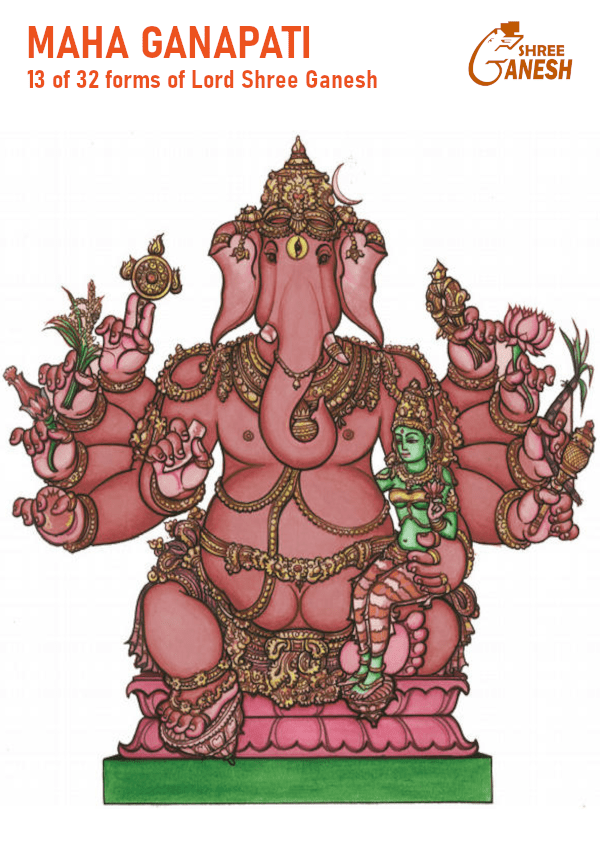
Maha Ganapati (महा गणपति) is the 13th of the 32 forms of Lord Ganesha. Accompanied by one of his shaktis, Maha Ganapati, “the Great,” is red-complexioned and three-eyed. He holds his tusk, a pomegranate, a blue lily, a sugarcane bow, a discus, a noose, a lotus, a sprig of rice, a mace and a pot of gems.
Maha means “great,” and Mahaganapati is one of the best-loved names of Ganesha: the Great Lord of the ganas, the Lord of all. Of the 32 forms, he is one of the most widely worshipped, and he is important in the Tantric worship of Ganesha.
The 32 forms are listed in the Mudgala Purana, and their meditation verses and paintings are preserved in the Sritattvanidhi, a nineteenth-century treatise from the court of Mysore.
The Form of Maha Ganapati
Red and three-eyed
His meditation verse describes him as aruṇacchāya, red as the dawn, the colour of energy and action. Like his father Shiva, he has three eyes, trinetra: the third is the eye of wisdom, which sees beyond the outer world.
The crescent moon
The verse also calls him indu-cūḍa, “crowned with the moon.” He wears the crescent moon on his head as Shiva does, another sign that he shares his father’s greatness.
Embraced by his shakti
A goddess sits on his lap: his shakti, his own power in female form. The verse says that she lovingly and always embraces him, and that she holds a lotus in her hand. Together they show that Ganesha’s power is never apart from him, and that the masculine and feminine sides of the divine are one.
Ten Arms and What They Hold
Maha Ganapati has ten arms, and each holds something. The verse lists them in this order:
- A citron or pomegranate (bijapura), the seed-filled fruit, for abundance and creation. The overview of the 32 forms calls it a pomegranate; the Sanskrit word more usually means a citron.
- A mace (gada), for strength and power.
- A sugarcane bow (ikshu karmuka), the bow of sweetness, for the mind’s desires brought under control.
- A discus (chakra), shining, the wheel of time and of the universe.
- A lotus (abja), for purity and spiritual unfolding.
- A noose (pasha), to draw the devotee close.
- A blue lily (utpala), the night-blooming water lily, for beauty.
- A sprig of rice (vrihi agra), the ripe ear of paddy, for nourishment and plenty.
- His own tusk (svavishana), the sign of sacrifice.
- A pot of gems (ratna kalasha), for wealth.
Some modern lists give a conch in place of one of these, but the meditation verse names no conch.
The Meditation Verse
The Sritattvanidhi gives this dhyana shloka for Maha Ganapati:
हस्तीन्द्राननमिन्दुचूडमरुणच्छायं त्रिनेत्रं रसा-
दाश्लिष्टं प्रियया सपद्मकरया स्वाङ्कस्थया सन्ततम् ।
बीजापूरगदेक्षुकार्मुकलसच्चक्राब्जपाशोत्पल-
व्रीह्यग्रस्वविषाणरत्नकलशान् हस्तैर्वहन्तं भजे ॥
hastīndrānanam indu-cūḍam aruṇacchāyaṃ trinetraṃ rasād / āśliṣṭaṃ priyayā sapadmakarayā svāṅkasthayā santatam / bījāpūra-gadekṣu-kārmuka-lasac-cakrābja-pāśotpala- / vrīhyagra-svaviṣāṇa-ratnakalaśān hastair vahantaṃ bhaje
In English: “I worship him who has the face of the lord of elephants, who is crowned with the moon, red in hue and three-eyed; who is always lovingly embraced by his beloved, seated on his lap with a lotus in her hand; and who carries in his hands a citron, a mace, a sugarcane bow, a shining discus, a lotus, a noose, a blue lily, a sprig of rice, his own tusk and a pot of gems.”
Mahaganapati of Ranjangaon
At Ranjangaon in Maharashtra, one of the eight Ashtavinayaka shrines, the deity is Mahaganapati, seated on a lotus with his consorts. Tradition holds that Lord Shiva worshipped Ganesha here before he went to battle against the demon Tripurasura, and won. You can read more in Shree Mahaganapati Temple, Ranjangaon and in Ashtavinayaka: Eight Ganesha Shrines in Maharashtra.
The Significance of Maha Ganapati
Maha Ganapati gathers into one form nearly every gift Ganesha gives. His hands hold the means of overcoming obstacles, the mace, the discus, the noose and the bow, and the signs of abundance, the fruit, the rice, the lotus and the pot of gems. His third eye and crescent moon mark him as the son of Shiva, and the goddess on his lap shows that his power is always with him. Devotees worship him for success, prosperity and the fulfilment of wishes, as the Great Lord who holds all of these.
He is one of the first sixteen forms, the Shodasha Ganapati. As Loving Ganesha records, these sixteen are installed in an eight-sided, chariot-shaped shrine at the Shri Shankara Mandapam in Rameshvaram, South India, established by Shri Chandrasekharendra Saraswati, the 68th head of the Kanchi Kamakoti Pitham.
The 32 forms, Maha Ganapati among them, are carved in stone at the Srikanteshvara temple in Nanjangud and the Chamarajeshvara temple in Chamarajanagar, both in Karnataka, and in the Pazhavangadi Ganapathy temple in Thiruvananthapuram, Kerala.
Conclusion
Maha Ganapati, the Great, sits red and three-eyed with the crescent moon on his head and his shakti on his lap. In ten hands he holds weapons and gifts alike, from mace and discus to rice and gems: everything a devotee might need, held by the Lord of all.
Frequently asked questions
- Who is Maha Ganapati?
Maha Ganapati (महा गणपति) is the 13th of the 32 forms of Lord Ganesha, “the Great,” red-complexioned and three-eyed, accompanied by his shakti.
- What does Maha Ganapati hold?
He has ten arms, holding a citron or pomegranate, a mace, a sugarcane bow, a discus, a lotus, a noose, a blue lily, a sprig of rice, his own tusk and a pot of gems.
- Who is the goddess with Maha Ganapati?
She is his shakti, his power in female form. The verse describes her seated on his lap, holding a lotus, and lovingly embracing him.
- Why does Maha Ganapati have three eyes and a crescent moon?
Like his father Shiva, he has a third eye, the eye of wisdom, and wears the crescent moon on his head.
- Where is Maha Ganapati worshipped?
He is one of the most widely worshipped forms of Ganesha. At Ranjangaon in Maharashtra, one of the eight Ashtavinayaka shrines, the deity is Mahaganapati.
- Why do devotees worship Maha Ganapati?
As the Great Lord who holds every gift of abundance and every means of overcoming obstacles, he is worshipped for success, prosperity and the fulfilment of wishes.
Continue reading
About Lord Ganesha →
About Lord Ganesha
Pray to Lord Ganesha Online
About Lord Ganesha
Sankatahara Ganapati: The Dispeller of Sorrow
About Lord Ganesha