
Nritya Ganapati: The Divine Dancer
On this page
Introduction
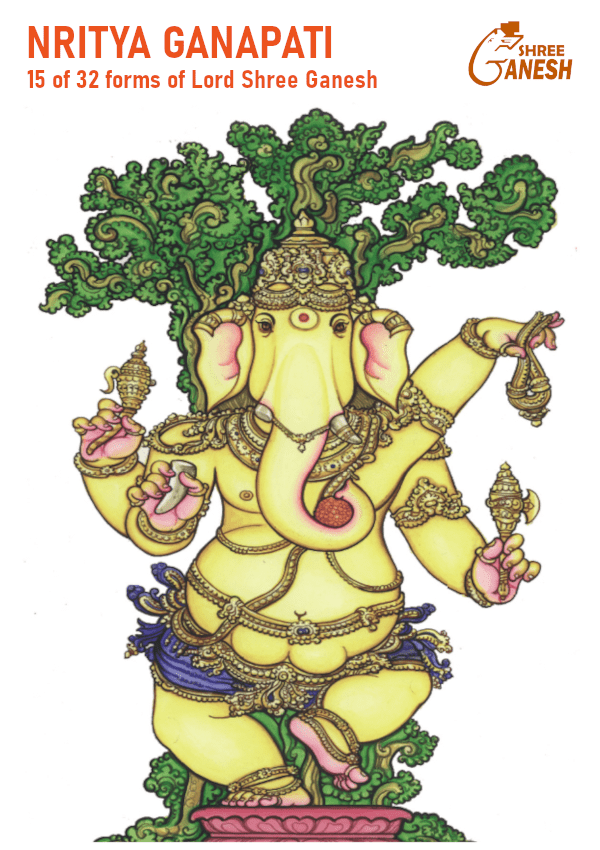
Nritya Ganapati (नृत्य गणपति) is the 15th of the 32 forms of Lord Ganesha. The happy “Dancer,” Nritya Ganapati, is four-armed and golden, with rings on his fingers, holding a tusk, a goad, a noose and a sweet. He dances beneath the kalpavriksha tree, the very picture of joyful activity.
Nritya means “dance.” His meditation verse uses the closely related word nṛtta, pure dance, and so this form is also called Nritta Ganapati. Of all the 32 forms, he is the one in motion.
The 32 forms are listed in the Mudgala Purana, and their meditation verses and paintings are preserved in the Sritattvanidhi, a nineteenth-century treatise from the court of Mysore.
The Form of Nritya Ganapati
Golden
His meditation verse calls him pītaprabha, shining with a golden-yellow light. Gold is the colour of joy, richness and light.
The dance
Nritya Ganapati is shown dancing, one leg raised, his body swaying and his arms moving with the rhythm. His great belly and elephant head do not weigh him down: the dance is light and happy. He is the son of Shiva Nataraja, the Lord of Dance, whose dance creates and dissolves the world, and in his own dance the same rhythm becomes playful and full of joy.
Rings on his fingers
The verse notices a small detail: his moving hands are fitted with fine rings. It is a sign of festivity, of a Lord dressed for celebration.
Under the wish-fulfilling tree
He dances beneath the kalpataru or kalpavriksha, the heavenly tree that grants every wish. The tree is the setting of his joy: a dance of fulfilment, where every true need is met.
Four Arms and What They Hold
Nritya Ganapati has four arms. The meditation verse names five things: a noose, a goad, a sweet cake, an axe and his tusk. The overview of the 32 forms gives four, a tusk, goad, noose and modaka, and leaves out the axe; some paintings place the sweet in his trunk so that the four hands hold the rest.
- A noose (pasha), to draw the devotee close and bind the mind to its goal.
- A goad (ankusha), to spur the devotee onward, as a mahout guides an elephant.
- An axe (kuthara), to cut the bonds of ignorance and attachment.
- His tusk (danta), the sign of sacrifice.
- A sweet cake (apupa), which the overview calls a modaka: the sweetness of the realised inner self, and the joy of spiritual reward.
The Meditation Verse
The Sritattvanidhi gives this dhyana shloka for Nritya Ganapati:
पाशाङ्कुशापूपकुठारदन्त-
चञ्चत्कराक्लुप्तवराङ्गुलीकम् ।
पीतप्रभं कल्पतरोरधस्थं
भजामि नृत्तोपपदं गणेशम् ॥
pāśāṅkuśāpūpa-kuṭhāra-danta- / cañcat-karāklupta-varāṅgulīkam / pītaprabhaṃ kalpataror adhasthaṃ / bhajāmi nṛttopapadaṃ gaṇeśam
In English: “I worship the Ganesha who is called the Dancer: golden in his radiance, standing beneath the wish-fulfilling tree, his moving hands, holding a noose, a goad, a sweet cake, an axe and his tusk, fitted with fine rings.”
The Dancing Ganesha in Art
The dancing Ganesha is a well-loved subject of Indian sculpture. The form was popular in northern India, was later taken up in Nepal, and from there in Tibet. In an essay on Ganesha iconography reproduced in Loving Ganesha, Dr. L. S. Madhava Rao counts the dancing form as its own class of image and names two old examples: a small stone icon at Hariharakshetra, Subrahmanya, and a bronze in the Raghavendra Matha in Udupi. You can read it in the book’s chapter on the Forms of Ganesha.
Ganesha is the patron of the arts and is worshipped at the start of every undertaking, so dancers and musicians pray to him before a performance, and many classical dance recitals begin with an invocation to him.
The Significance of Nritya Ganapati
Nritya Ganapati shows a side of the divine that is easy to forget: joy. The Lord who removes obstacles also dances, and his dance beneath the wish-fulfilling tree is a picture of a life lived freely and happily, once the obstacles are gone. His noose, goad and axe are still in his hands, for discipline is part of the dance, but the sweet in his hand and the rings on his fingers speak of celebration.
He is one of the first sixteen forms, the Shodasha Ganapati. As Loving Ganesha records, these sixteen are installed in an eight-sided, chariot-shaped shrine at the Shri Shankara Mandapam in Rameshvaram, South India, established by Shri Chandrasekharendra Saraswati, the 68th head of the Kanchi Kamakoti Pitham.
The 32 forms, Nritya Ganapati among them, are carved in stone at the Srikanteshvara temple in Nanjangud and the Chamarajeshvara temple in Chamarajanagar, both in Karnataka, and in the Pazhavangadi Ganapathy temple in Thiruvananthapuram, Kerala.
Conclusion
Nritya Ganapati, the Dancer, moves golden and joyful beneath the wish-fulfilling tree, rings shining on his fingers, his tusk, goad, noose and sweet in his hands. He is the patron of every artist and the picture of a happy heart, inviting his devotees to take up the rhythm of a life lived in devotion and joy.
Frequently asked questions
- Who is Nritya Ganapati?
Nritya Ganapati (नृत्य गणपति) is the 15th of the 32 forms of Lord Ganesha, the happy “Dancer,” four-armed and golden, dancing under the wish-fulfilling kalpavriksha tree.
- What does Nritya mean?
Nritya means “dance.” His meditation verse uses the closely related word nritta, so this form is also called Nritta Ganapati.
- What does Nritya Ganapati hold?
His meditation verse names a noose, a goad, a sweet cake, an axe and his tusk, and says his fingers wear fine rings. The overview of the 32 forms gives a tusk, goad, noose and modaka.
- Why does he dance under the kalpavriksha?
The kalpavriksha is the tree that grants every wish. Dancing beneath it, Nritya Ganapati shows the joy of a life in which every true need is met.
- Where are dancing Ganesha images found?
The dancing Ganesha was popular in northern India, was later taken up in Nepal and then in Tibet, and is a well-loved subject of Indian sculpture.
- Why do dancers worship Nritya Ganapati?
Ganesha is the patron of the arts and is invoked at the start of every undertaking, so dancers and musicians pray to him before a performance.
Continue reading
About Lord Ganesha →
About Lord Ganesha
Pray to Lord Ganesha Online
About Lord Ganesha
Sankatahara Ganapati: The Dispeller of Sorrow
About Lord Ganesha