
Siddhi Ganapati: The Epitome of Achievement and Self-Mastery
On this page
Introduction
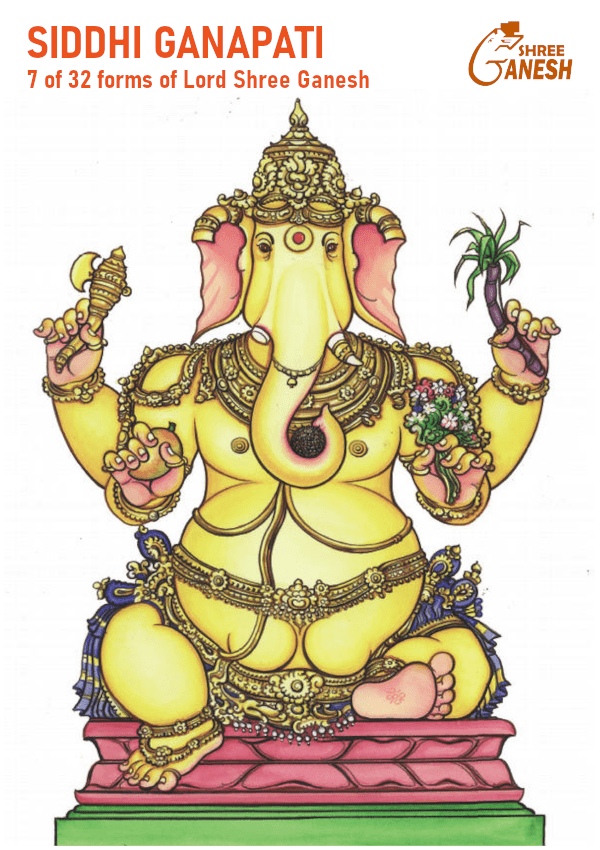
Siddhi Ganapati (सिद्धि गणपति) is the 7th of the 32 forms of Lord Ganesha. Golden-yellow Siddhi Ganapati, “the Accomplished,” is the epitome of achievement and self-mastery. He sits comfortably holding a bouquet of flowers, an axe, a mango and sugarcane, and in his trunk he holds a tasty sesame sweet.
Siddhi means accomplishment or success. In daily life it is a task brought to its end; in spiritual life it is the mastery that comes from long and steady practice. In Hindu tradition Siddhi is also the name of one of Ganesha’s two consorts, with Buddhi, wisdom, as told in Lord Ganesha’s Wedding with Siddhi and Buddhi. Success and wisdom stand at his side.
The 32 forms are listed in the Mudgala Purana, and their meditation verses and paintings are preserved in the Sritattvanidhi, a nineteenth-century treatise from the court of Mysore. This article looks at how Siddhi Ganapati is described there, and what his form means.
The Form of Siddhi Ganapati
Golden-tawny
His meditation verse calls him hema-piṅgala, golden-tawny: a deep yellow touched with the glow of gold. From this word he is also known as Pingala Ganapati. Gold is the colour of wealth, ripeness and success, and fits a form who stands for things brought to completion.
At ease
He sits at ease, comfortable and unhurried. Achievement in this form is not a struggle still under way. It is the calm of one who has already reached the goal.
Fortune and plenty
The verse calls him śrī-samṛddhi-yuta, “endowed with fortune and plenty.” Most of what he holds is food: fruit, sugarcane and sweets. They are the harvest that follows good work.
Four Arms and What They Hold
Siddhi Ganapati has four arms, and holds a fifth thing in his trunk.
- A ripe mango (pakva chuta), the fruit that has finished ripening. It stands for effort that has borne fruit.
- A spray of flowers (pushpa manjari), the blossoming of a person’s gifts and of the good that has been planted.
- A stalk of sugarcane (ikshu danda), the sweetness of success, which, like sugar from the cane, comes only after pressing and refining.
- An axe (parashu), to cut away attachments, bad habits and whatever stands in the way of the goal.
- A sesame sweet (tila modaka), held in his trunk. Sesame seeds are tiny, and a sweet made of them is many small seeds pressed into one: many small, steady efforts that together make an accomplishment.
Some modern lists give him a noose in place of the flowers. The meditation verse names the mango, flowers, sugarcane, sesame sweets and axe, and no noose.
The Meditation Verse
The Sritattvanidhi gives this dhyana shloka for Siddhi Ganapati:
पक्वचूतफलपुष्पमञ्जरीरिक्षुदण्डतिलमोदकैः सह ।
उद्वहन् परशुमस्तु ते नमः श्रीसमृद्धियुत हेमपिङ्गल ॥
pakvacūtaphalapuṣpamañjarīr ikṣudaṇḍatilamodakaiḥ saha / udvahan paraśum astu te namaḥ śrīsamṛddhiyuta hemapiṅgala
In English: “O golden-tawny Lord, endowed with fortune and plenty, who carries a ripe mango, a spray of flowers, a stalk of sugarcane and sesame sweets, together with an axe: salutations to you.”
Siddhi Ganapati and Siddhivinayak
Several famous temples call Ganesha Siddhivinayak, the Ganesha who grants success. Among them are the Siddhivinayak temple of Mumbai and the Siddhivinayak temple of Siddhatek, one of the eight Ashtavinayaka shrines of Maharashtra. These temples share the idea of siddhi with this form, but their images have their own iconography: the Mumbai image, for example, holds a lotus, an axe, beads and a bowl of modakas. Siddhi Ganapati is the form described in the Sritattvanidhi verse above.
The Significance of Siddhi Ganapati
Devotees turn to Siddhi Ganapati for success: in studies, in work and in any undertaking, and for prosperity in the home. Those on a spiritual path ask him for mastery of their practice and of themselves.
His form teaches how accomplishment comes. The axe clears the way; the sesame sweet, many seeds in one, shows that success is built from small and steady efforts; and the ripe mango and the sugarcane show the sweetness that follows. The verse closes with a simple salutation, astu te namaḥ, “salutations to you,” offered to the Lord of fortune and plenty.
He is one of the first sixteen forms, the Shodasha Ganapati. As Loving Ganesha records, these sixteen are installed in an eight-sided, chariot-shaped shrine at the Shri Shankara Mandapam in Rameshvaram, South India, established by Shri Chandrasekharendra Saraswati, the 68th head of the Kanchi Kamakoti Pitham.
The 32 forms, Siddhi Ganapati among them, are carved in stone at the Srikanteshvara temple in Nanjangud and the Chamarajeshvara temple in Chamarajanagar, both in Karnataka, and in the Pazhavangadi Ganapathy temple in Thiruvananthapuram, Kerala.
Conclusion
Siddhi Ganapati, golden-tawny and at ease, holds the harvest of good work: the ripe mango, the flowers, the sugarcane and the sesame sweet, with the axe that cleared the way. He is the Accomplished, and he reminds his devotees that mastery is built one small effort at a time.
Frequently asked questions
- Who is Siddhi Ganapati?
Siddhi Ganapati (सिद्धि गणपति) is the 7th of the 32 forms of Lord Ganesha, “the Accomplished,” golden-yellow in colour and the epitome of achievement and self-mastery.
- What does Siddhi mean?
Siddhi means accomplishment or success: the fulfilment of a task, and in spiritual life the mastery that comes from long practice.
- Why is he also called Pingala Ganapati?
His meditation verse calls him hema-pingala, golden-tawny, and so he is also known as Pingala Ganapati.
- What does Siddhi Ganapati hold?
A ripe mango, a spray of flowers, a stalk of sugarcane and an axe, with a sesame sweet held in his trunk.
- Is Siddhi Ganapati the same as Siddhivinayak?
They share the name, not the form. Siddhivinayak of Mumbai and of Siddhatek are temple images with their own iconography; Siddhi Ganapati is the 7th of the 32 forms as described in the Sritattvanidhi.
- Why do devotees worship Siddhi Ganapati?
Devotees seek his blessing for success in their work and studies, for prosperity, and for mastery in spiritual practice.
Continue reading
About Lord Ganesha →
About Lord Ganesha
Pray to Lord Ganesha Online
About Lord Ganesha
Sankatahara Ganapati: The Dispeller of Sorrow
About Lord Ganesha