
Simha Ganapati: The Lion-Faced Lord of Courage
On this page
Introduction
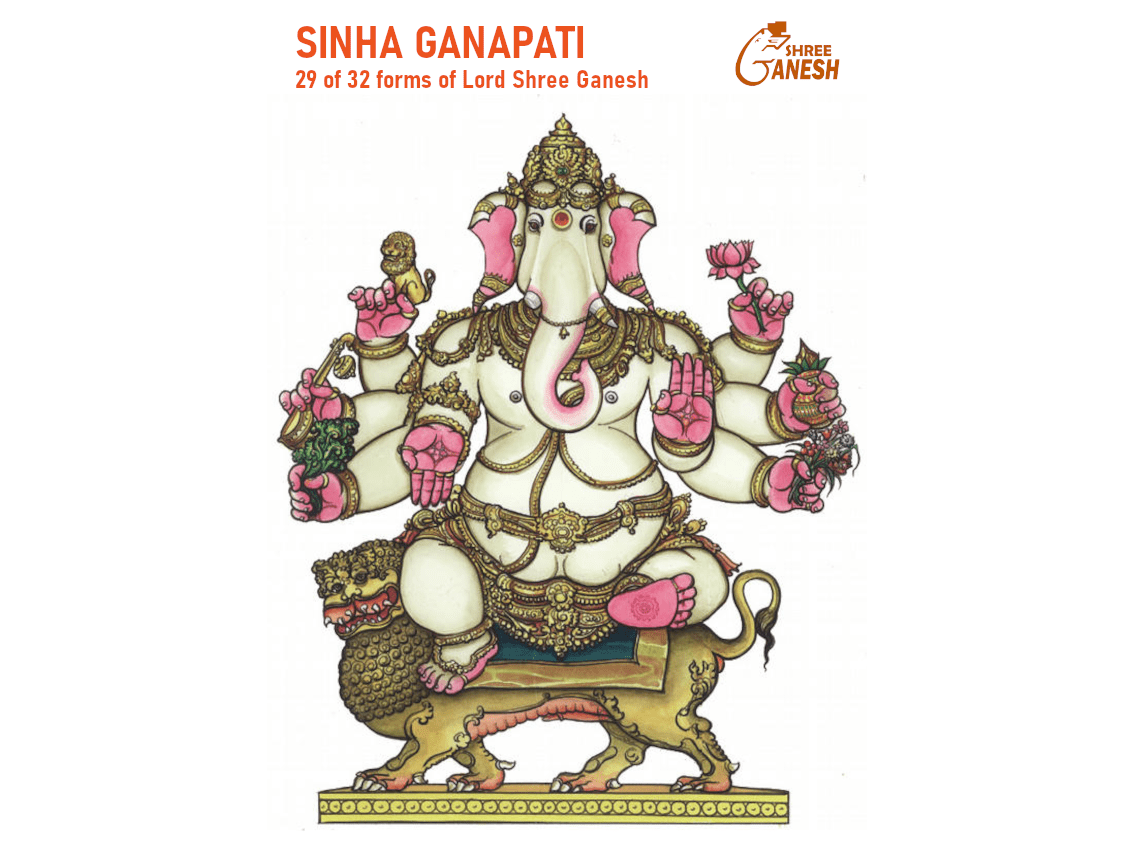
Simha Ganapati (सिंह गणपति) is the 29th of the 32 forms of Lord Ganesha. Simha means “lion,” and this is the form of Ganesha bound up with the lion’s strength and fearlessness. He is white in colour, and his eight hands hold symbols of both power and gentleness: a discus beside a vina, a pot of jewels beside a cluster of flowers.
The 32 forms are listed in the Mudgala Purana, and their meditation verses and paintings are preserved in the Sritattvanidhi, a nineteenth-century treatise from the court of Mysore. This article looks at how Simha Ganapati is described, and what his form means.
The Lion and the Elephant
The lion appears in two ways in descriptions of this form.
In the meditation verse of the Sritattvanidhi, Simha Ganapati has a lion’s face graced by an elephant’s trunk, joining the king of beasts to the elephant-headed Lord. In the better-known description from the Himalayan Academy, he rides a lion and displays another lion in one hand. Either way, the meaning is the same: the lion is courage, royal power and the strength that fears nothing.
Ganesha is often shown with a lion. In the Ganesha Purana, his incarnation in the first age, Mahotkata Vinayaka, rides a lion, and the five-faced Heramba Ganapati, “Protector of the Weak,” rides one too.
White as the Conch and the Moon
Simha Ganapati is white, “like a conch and the moon,” and wears a robe that shines like jewels. White is the colour of purity and peace, and it softens the force of the lion: this is strength held in calm, not strength out of control.
Eight Arms and What They Hold
His eight arms hold, on the right:
- A vina, the stringed instrument of Saraswati, goddess of learning and the arts: courage joined to culture and refinement.
- A wish-granting creeper (kalpalata), from the heavenly tree that grants every wish, a sign of the abundance he gives.
- A discus (chakra), the spinning weapon that cuts through ignorance and evil.
- The boon-giving gesture (varada mudra).
And on the left:
- A lotus, for purity and spiritual unfolding.
- A pot of jewels (ratna kalasha), the riches, inner and outer, that he keeps for his devotees.
- A cluster of flowers (manjari), for beauty and devotion.
- The gesture of fearlessness (abhaya mudra), fitting for the lion form above all.
The Meditation Verse
The Sritattvanidhi gives this dhyana shloka for Simha Ganapati:
वीणां कल्पलतामरिं च वरदं दक्षे विधत्ते करैः
वामे तामरसं च रत्नकलशं सन्मञ्जरीं चाभयम् ।
शुण्डादण्डलसन्मृगेन्द्रवदनः शङ्खेन्दुगौरः शुभो
दीव्यद्रत्ननिभांशुको गणपतिः पायादपायात् स नः ॥
vīṇāṃ kalpalatām ariṃ ca varadaṃ dakṣe vidhatte karaiḥ / vāme tāmarasaṃ ca ratnakalaśaṃ sanmañjarīṃ cābhayam / śuṇḍādaṇḍalasanmṛgendravadanaḥ śaṅkhendugauraḥ śubho / dīvyadratnanibhāṃśuko gaṇapatiḥ pāyād apāyāt sa naḥ
In English: “May that auspicious Ganapati protect us from harm: with a lion’s face graced by a trunk, white as a conch or the moon, wearing a robe that shines like jewels. In his right hands he holds a vina, a wish-granting creeper and a discus and gives boons; in his left he holds a lotus, a jewelled pot and a fine cluster of flowers and gives fearlessness.”
The Significance of Simha Ganapati
Devotees turn to Simha Ganapati for strength, courage and fearlessness, and for protection from harm and from enemies. His verse ends with the prayer pāyād apāyāt, “may he protect us from danger.”
His form also teaches balance. The lion and the discus stand for power, but the vina, the flowers and the lotus stand for beauty and devotion. True courage, in this form, is not harshness: it is strength that can protect because it is at peace.
The 32 forms, Simha Ganapati among them, are carved in stone at the Srikanteshvara temple in Nanjangud and the Chamarajeshvara temple in Chamarajanagar, both in Karnataka, and in the Pazhavangadi Ganapathy temple in Thiruvananthapuram, Kerala.
Conclusion
Simha Ganapati, white as the moon and bound up with the lion, is the Lord who gives his devotees courage. With one hand he raises the discus and with another the vina; with one he offers jewels and with another he says, “do not fear.” In him, strength and gentleness are one.
Frequently asked questions
- Who is Simha Ganapati?
Simha Ganapati (सिंह गणपति) is the 29th of the 32 forms of Lord Ganesha, the white Lord associated with the lion, symbol of strength and fearlessness.
- What does Simha mean?
Simha means “lion.” In his meditation verse he has a lion’s face graced by an elephant’s trunk; in other descriptions he rides a lion and holds another in one hand.
- What does Simha Ganapati hold?
In his right hands a vina, a wish-granting creeper and a discus, with the boon-giving gesture; in his left a lotus, a pot of jewels and a cluster of flowers, with the gesture of fearlessness.
- What colour is Simha Ganapati?
He is white, like a conch shell or the moon, and wears a robe that shines like jewels.
- Why do devotees worship Simha Ganapati?
For strength, courage and fearlessness, and for protection from harm; his verse asks him to protect us from danger.
Continue reading
About Lord Ganesha →
About Lord Ganesha
Pray to Lord Ganesha Online
About Lord Ganesha
Sankatahara Ganapati: The Dispeller of Sorrow
About Lord Ganesha