
Taruna Ganapati: The Youthful Lord with Eight Arms
On this page
Introduction
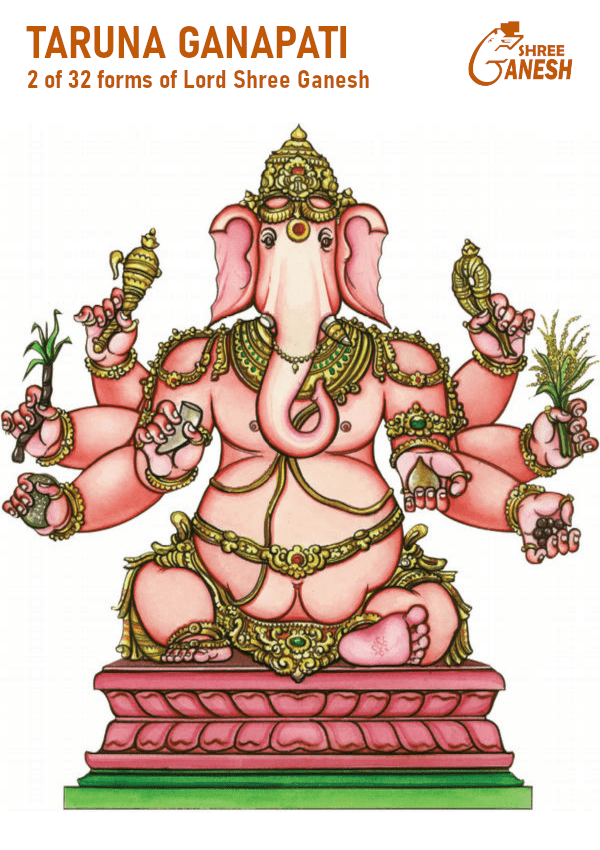
Taruna Ganapati (तरुण गणपति) is the second of the 32 forms of Lord Ganesha. Eight-armed, Taruna Ganapati, “the Youthful,” holds a noose and goad, a sweet cake, a wood apple, a rose apple, his broken tusk, a sprig of paddy and a sugarcane stalk. His brilliant red colour reflects the blossoming of youth.
Taruna means “young” or “youthful.” Where Bala Ganapati, the first form, is a small child, Taruna Ganapati is Ganesha grown into a young man, full of strength and energy, his hands no longer holding only sweets but also the tools with which he guides his devotees.
The 32 forms are listed in the Mudgala Purana, and their meditation verses and paintings are preserved in the Sritattvanidhi, a nineteenth-century treatise from the court of Mysore.
The Form of Taruna Ganapati
Youth
Taruna Ganapati is shown as a young man with an elephant face, alert and strong. Youth in Hindu thought is the time of greatest energy, when a person can take up any task. The child plays; the young man acts. Taruna Ganapati shows Ganesha’s power at its freshest.
Red as the young dawn
His meditation verse calls him taruṇāruṇābha, “shining with the red of the young dawn.” The word taruṇa appears twice in the verse: he is young, and his colour is that of the young sun, the deep red of early morning before it turns to gold. Red in Ganesha’s forms is the colour of energy and action.
Eight Arms and What They Hold
- The noose (pasha), which draws devotees close and holds back what would pull them away.
- The goad (ankusha), which spurs the devotee onward, as a mahout guides an elephant.
- A sweet cake (apupa), usually understood as the modaka, Ganesha’s favourite sweet. The version of the verse in the Mudgala Purana names the kadubu, the steamed sweet dumpling offered to Ganesha in Karnataka.
- A wood apple (kapittha), a hard-shelled fruit sacred in Ganesha worship and often offered to him.
- A rose apple (jambu), the fruit after which Jambudvipa, the ancient name for India, is called.
- His own tusk (svadanta), broken off, the sign of sacrifice.
- A sprig of paddy (shali), ears of rice, for the harvest and the food it gives.
- A stalk of sugarcane (ikshu), for sweetness and plenty.
The verse names these eight things for his eight hands. One English translation gives guava for kapittha, but the word means the wood apple. A few printed versions of the verse read the second line differently, but the version preserved with the Sritattvanidhi painting is the one given below.
The Meditation Verse
The Sritattvanidhi gives this dhyana shloka for Taruna Ganapati:
पाशाङ्कुशापूपकपित्थजम्बू-
स्वदन्तशालीक्षुमपि स्वहस्तैः ।
धत्ते सदा यस्तरुणारुणाभः
पायात् स युष्मांस्तरुणो गणेशः ॥
pāśāṅkuśāpūpa-kapittha-jambū- / svadanta-śālīkṣum api svahastaiḥ / dhatte sadā yas taruṇāruṇābhaḥ / pāyāt sa yuṣmāṃs taruṇo gaṇeśaḥ
In English: “May that youthful Ganesha protect you, who shines with the red of the young dawn, and who always holds in his own hands the noose, the goad, a sweet cake, a wood apple, a rose apple, his own tusk, ears of rice and sugarcane.”
The Broken Tusk
Taruna Ganapati holds his own tusk, and well-known stories tell how Ganesha lost it. In one, he broke it off to use as a pen, so that he could keep writing the Mahabharata as the sage Vyasa recited it without a pause. In another, it was struck off in a fight with Parashurama, told in Ganesha and Parashurama. In a third, he broke it off and threw it at the moon, which had laughed at him, told in Lord Ganesha’s Broken Tusk. In the first two, the tusk stands for a sacrifice made for a higher purpose.
The Significance of Taruna Ganapati
Taruna Ganapati holds the tools of guidance and the fruits of the earth side by side. His noose and goad steer and steady the devotee; his fruits, his rice and his sugarcane promise a full harvest to those who work for it; his broken tusk recalls the sacrifice that every real achievement asks for. Devotees turn to him for the energy and focus of youth, and for help in putting that energy to good use. The verse ends with a simple prayer: pāyāt, “may he protect.”
He is one of the first sixteen forms, the Shodasha Ganapati. As Loving Ganesha records, these sixteen are installed in an eight-sided, chariot-shaped shrine at the Shri Shankara Mandapam in Rameshvaram, South India, established by Shri Chandrasekharendra Saraswati, the 68th head of the Kanchi Kamakoti Pitham.
The 32 forms, Taruna Ganapati among them, are carved in stone at the Srikanteshvara temple in Nanjangud and the Chamarajeshvara temple in Chamarajanagar, both in Karnataka, and in the Pazhavangadi Ganapathy temple in Thiruvananthapuram, Kerala.
Conclusion
Taruna Ganapati, the Youthful, glows with the red of the young dawn. In his eight hands he holds the noose and goad that guide, the fruits, rice and sugarcane that nourish, and the broken tusk that teaches sacrifice. He is Ganesha in the strength of youth, protecting those who call on him.
Frequently asked questions
- Who is Taruna Ganapati?
Taruna Ganapati (तरुण गणपति) is the second of the 32 forms of Lord Ganesha, “the Youthful,” an eight-armed Ganesha of brilliant red colour.
- What does Taruna mean?
Taruna means “young” or “youthful”: Ganesha no longer a small child but a young man in the fullness of his strength.
- What does Taruna Ganapati hold?
A noose, a goad, a sweet cake, a wood apple, a rose apple, his own broken tusk, a sprig of paddy and a stalk of sugarcane.
- Why is Taruna Ganapati red?
His meditation verse says he shines with the red of the young dawn, taruṇāruṇa. His brilliant red reflects the blossoming of youth.
- What does the meditation verse of Taruna Ganapati ask?
It ends with a prayer for protection: “may that youthful Ganesha protect you.”
Continue reading
About Lord Ganesha →
About Lord Ganesha
Pray to Lord Ganesha Online
About Lord Ganesha
Sankatahara Ganapati: The Dispeller of Sorrow
About Lord Ganesha