
Trimukha Ganapati: The Three-Faced Lord
On this page
Introduction
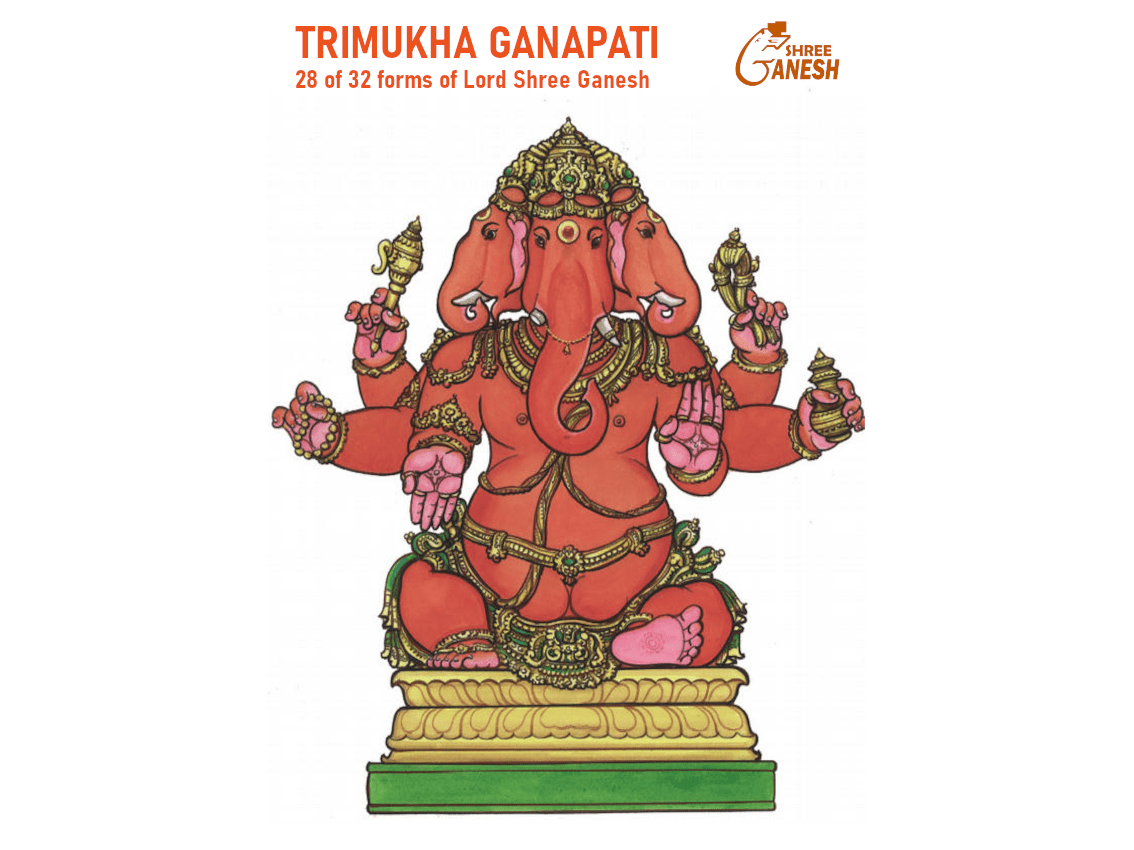
Trimukha Ganapati (त्रिमुख गणपति) is the 28th of the 32 forms of Lord Ganesha. His name means “three-faced,” from tri, three, and mukha, face. He is the contemplative Lord of red hue who sits on a golden lotus, telling his beads, holding a noose, a goad and a vessel of nectar, and gesturing protection and blessing.
The 32 forms are listed in the Mudgala Purana, and their meditation verses and paintings are preserved in the Sritattvanidhi, a nineteenth-century treatise from the court of Mysore. Each verse describes one form so that a devotee can hold it in the mind during worship. This article looks at how Trimukha Ganapati is described there, and what his form means.
The Form of Trimukha Ganapati
Three faces
Where most forms of Ganesha have one elephant face, Trimukha Ganapati has three, looking in different directions. The faces are often read in threes that run all through Hindu thought: Brahma, Vishnu and Shiva, who create, preserve and dissolve the world; past, present and future; or will, knowledge and action. However they are read, the meaning is the same: a Lord who sees everything at once, and from whom nothing is hidden.
Red as the palasha flower
His meditation verse compares his colour to the palasha, the “flame of the forest,” a tree whose flowers turn whole hillsides a burning orange-red in spring. Red in Ganesha’s forms is the colour of energy and action, and the palasha is a sacred tree in its own right, used in Vedic ritual.
The golden lotus seat
He sits on a golden lotus whose bright centre shines beneath him. The lotus rises clean from muddy water, and so stands for purity and spiritual unfolding; gold adds richness and light.
Six Arms and What They Hold
Trimukha Ganapati has six arms, three on each side.
- The goad (ankusha), sharp-pointed, in a right hand. It spurs the devotee onward, as a mahout guides an elephant.
- The rosary (akshamala), in a right hand. Telling his beads, he is shown absorbed in prayer and japa, the repetition of a mantra.
- The boon-giving gesture (varada mudra), with the third right hand turned down and open, granting the wishes of devotees.
- The noose (pasha), in a left hand. It draws the devotee close and holds back what would pull them away.
- A pot full of amrita, the nectar of immortality, in a left hand: the sweetness and lasting reward of spiritual life.
- The gesture of fearlessness (abhaya mudra), with the third left hand raised and open, saying “do not fear.”
Some modern sources place these items on the opposite sides, but the meditation verse is clear: goad, rosary and boon on the right; noose, nectar and fearlessness on the left.
The Meditation Verse
The Sritattvanidhi gives this dhyana shloka for Trimukha Ganapati:
श्रीमत्तीक्ष्णशिखाङ्कुशाक्षवरदान् दक्षे दधानः करैः
पाशं चामृतपूर्णकुम्भमभयं वामे दधानो मुदा ।
पीठे स्वर्णमयारविन्दविलसत्सत्कर्णिकाभासुरे
स्वासीनस्त्रिमुखः पलाशरुचिरो नागाननः पातु नः ॥
śrīmattīkṣṇaśikhāṅkuśākṣavaradān dakṣe dadhānaḥ karaiḥ / pāśaṃ cāmṛtapūrṇakumbham abhayaṃ vāme dadhāno mudā / pīṭhe svarṇamayāravindavilasatsatkarṇikābhāsure / svāsīnas trimukhaḥ palāśarucir nāgānanaḥ pātu naḥ
In English: “May the three-faced, elephant-faced Lord, radiant as the palasha flower, protect us. In his right hands he joyfully holds a sharp goad and a rosary and gives boons; in his left he holds a noose and a pot full of nectar and gives fearlessness. He sits at ease on a golden lotus seat, bright with its shining centre.”
The Significance of Trimukha Ganapati
The verse ends with a simple prayer: pātu naḥ, “may he protect us.” Devotees turn to Trimukha Ganapati for protection and for a steady, clear mind. His three faces remind them that the divine sees every side of a situation, and his beads and nectar point to the reward of patient, regular prayer.
The 32 forms, Trimukha Ganapati among them, are carved in stone at the Srikanteshvara temple in Nanjangud and the Chamarajeshvara temple in Chamarajanagar, both in Karnataka, and in the Pazhavangadi Ganapathy temple in Thiruvananthapuram, Kerala.
Conclusion
Trimukha Ganapati, the three-faced Lord, sits calm and red-hued on his golden lotus, seeing in every direction at once. With goad and noose he guides and holds his devotees; with beads and nectar he shows the way of prayer; with his open hands he gives boons and takes away fear.
Frequently asked questions
- Who is Trimukha Ganapati?
Trimukha Ganapati (त्रिमुख गणपति) is the 28th of the 32 forms of Lord Ganesha, the contemplative three-faced Lord of red hue who sits on a golden lotus.
- What does Trimukha mean?
Trimukha means “three-faced,” from tri, three, and mukha, face.
- What does Trimukha Ganapati hold?
He has six arms. In his right hands he holds a sharp goad and a rosary and gives the boon-granting gesture; in his left he holds a noose and a pot of nectar and gives the gesture of fearlessness.
- What do the three faces stand for?
They are often read as Brahma, Vishnu and Shiva, as past, present and future, or as will, knowledge and action: a Lord who sees everything at once.
- Why do devotees worship Trimukha Ganapati?
His meditation verse asks him to protect us, and devotees turn to him for protection, steadiness and a mind that sees clearly.
Continue reading
About Lord Ganesha →
About Lord Ganesha
Pray to Lord Ganesha Online
About Lord Ganesha
Sankatahara Ganapati: The Dispeller of Sorrow
About Lord Ganesha