
Ucchishta Ganapati: The Lord of Blessed Offerings
On this page
Introduction
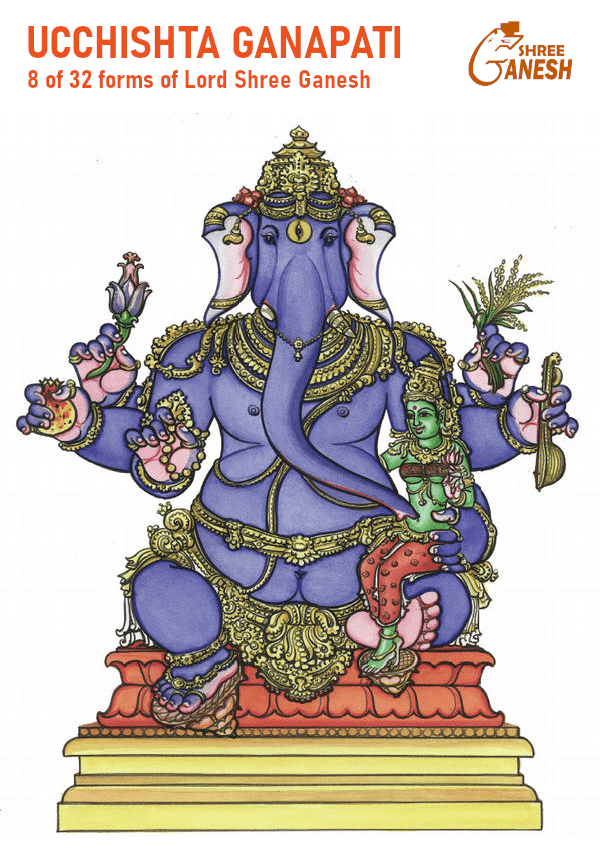
Ucchishta Ganapati (उच्छिष्ट गणपति) is the 8th of the 32 forms of Lord Ganesha. He is the “Lord of Blessed Offerings” and guardian of culture. Blue in colour and six-armed, he sits with his Shakti, holding a vina, a pomegranate, a blue lotus, a japa mala and a sprig of fresh rice.
Ucchishta means “what is left over,” the remainder. In worship it is the part of an offering that remains after it has been given to the deity, and so is blessed, like prasada, the food first offered to God and then shared among devotees as his gift. The word has an old and honoured place in Hindu thought: a whole hymn of the Atharvaveda (11.7) praises Ucchishta, the remainder, as what is left when all else has passed, and on which the world rests.
The 32 forms are listed in the Mudgala Purana, and their meditation verses and paintings are preserved in the Sritattvanidhi, a nineteenth-century treatise from the court of Mysore. This article looks at how Ucchishta Ganapati is described there, and what his form means.
The Form of Ucchishta Ganapati
Dark blue
His meditation verse calls him mecaka, dark blue, the colour of a rain cloud or a peacock’s throat. Blue is the colour of the sky and the ocean, of what is vast and without limit. Other texts describe Ucchishta Ganapati as red or dark, but the Sritattvanidhi verse gives blue.
Six arms
He has six arms. The verse names six things that he holds, and they are often shown in five hands, with the sixth arm resting around his consort.
Seated with his Shakti
Ucchishta Ganapati is one of the forms of Ganesha shown with his Shakti, the goddess who is his consort and his power, seated at his left side. In the Sritattvanidhi painting she is clothed and seated beside him. Shiva and Parvati, Vishnu and Lakshmi are worshipped together in the same way: the god and his power are one, and the pair stands for the union from which life and plenty come.
Six Arms and What They Hold
- A blue lotus (nilabja), the night-blooming water lily. It stands for purity and for the opening of the spirit.
- A pomegranate (dadimi), a fruit full of seeds, for fertility and abundance.
- A vina, the stringed instrument of Saraswati, goddess of learning. It stands for music, the arts and culture, and gives this form its name as their guardian.
- An ear of rice (shali), the fresh paddy of the harvest, for agriculture and the food that sustains life.
- Gunja berries, the small red-and-black seeds once used to weigh gold, for wealth measured with care.
- A rosary (akshasutra), the japa beads, for prayer and the repetition of a mantra.
The words guñjākṣasūtraka in the verse can also be read as one item, a rosary of gunja seeds, which leaves five things for five hands. Older versions of this article left the gunja out.
The Meditation Verse
The Sritattvanidhi gives this dhyana shloka for Ucchishta Ganapati:
नीलाब्जदाडिमीवीणाशालिगुञ्जाक्षसूत्रकम् ।
दधदुच्छिष्टनामायं गणेशः पातु मेचकः ॥
nīlābjadāḍimīvīṇāśāliguñjākṣasūtrakam / dadhad ucchiṣṭanāmāyaṃ gaṇeśaḥ pātu mecakaḥ
In English: “May this dark-blue Ganesha named Ucchishta protect us, holding a blue lotus, a pomegranate, a vina, an ear of rice, gunja berries and a rosary.”
Some versions of the verse end pātu mokṣadaḥ, “may the giver of liberation protect us,” in place of mecakaḥ, dark blue.
Ucchishta Ganapati in Tantric Worship
Ucchishta Ganapati is also an important form in tantric worship. The Ucchishta Ganapatyas were one of the six schools of Ganesha worship, and they followed their own tantric rites. In that tradition the name is also explained by a rule of practice: his mantra may be recited in a state of ucchishta, without the usual ritual cleansing, as with food still in the mouth. Ordinary worship of Ganesha asks for strict purity first. The rule is read as a sign that this form accepts the devotee as they are. These rites are passed on by initiation within the tradition, and are not described here.
The Uchchhishta Ganapathy Temple of Tirunelveli
At Manimoortheeswaram in Tirunelveli, Tamil Nadu, on the bank of the Tamirabharani river, stands a large temple dedicated to Ucchishta Ganapati. It is said to be about a thousand years old. Beside the main shrine it holds images of the other forms of Ganesha, and Vinayaka Chaturthi is celebrated there for ten days. Devotees come to pray especially for the blessing of children.
The Significance of Ucchishta Ganapati
Devotees turn to Ucchishta Ganapati for blessings on the family, for children, for harmony between husband and wife, and for success in music, the arts and learning. His rice and pomegranate speak of harvest and fertility; his vina of the culture that a settled, well-fed life makes possible; his lotus and beads of the prayer that holds it all together.
His name carries a teaching of its own. What remains after an offering is not waste but blessing. Whatever is given to God comes back as his gift, and the Lord of Blessed Offerings is the one who turns what is left into grace.
He is one of the first sixteen forms, the Shodasha Ganapati. As Loving Ganesha records, these sixteen are installed in an eight-sided, chariot-shaped shrine at the Shri Shankara Mandapam in Rameshvaram, South India, established by Shri Chandrasekharendra Saraswati, the 68th head of the Kanchi Kamakoti Pitham.
The 32 forms, Ucchishta Ganapati among them, are carved in stone at the Srikanteshvara temple in Nanjangud and the Chamarajeshvara temple in Chamarajanagar, both in Karnataka, and in the Pazhavangadi Ganapathy temple in Thiruvananthapuram, Kerala.
Conclusion
Ucchishta Ganapati, dark blue and six-armed, sits with his Shakti holding the vina, the lotus, the pomegranate, the rice, the gunja and the beads. He is the Lord of Blessed Offerings, for whom the remainder of an offering is grace, and the guardian of culture, of music and learning and of the harvest they grow from.
Frequently asked questions
- Who is Ucchishta Ganapati?
Ucchishta Ganapati (उच्छिष्ट गणपति) is the 8th of the 32 forms of Lord Ganesha, the “Lord of Blessed Offerings” and guardian of culture, blue in colour, six-armed and seated with his Shakti.
- What does Ucchishta mean?
Ucchishta means “what is left over”: the remainder of an offering. In devotion that remainder is blessed, like prasada, the food offered to the deity and shared with devotees.
- What does Ucchishta Ganapati hold?
His meditation verse names a blue lotus, a pomegranate, a vina, an ear of rice, gunja berries and a rosary.
- Who sits with Ucchishta Ganapati?
His Shakti, his consort and divine power, sits beside him on his left; in the Sritattvanidhi painting she is clothed and seated at his side.
- Why is he called the guardian of culture?
He holds the vina, the instrument of music and learning, beside the rice and pomegranate of harvest and plenty, and so is seen as the protector of the arts and of the life that culture grows from.
- Where is Ucchishta Ganapati worshipped?
The Uchchhishta Ganapathy temple at Manimoortheeswaram in Tirunelveli, Tamil Nadu, on the bank of the Tamirabharani river, is dedicated to this form.
Continue reading
About Lord Ganesha →
About Lord Ganesha
Pray to Lord Ganesha Online
About Lord Ganesha
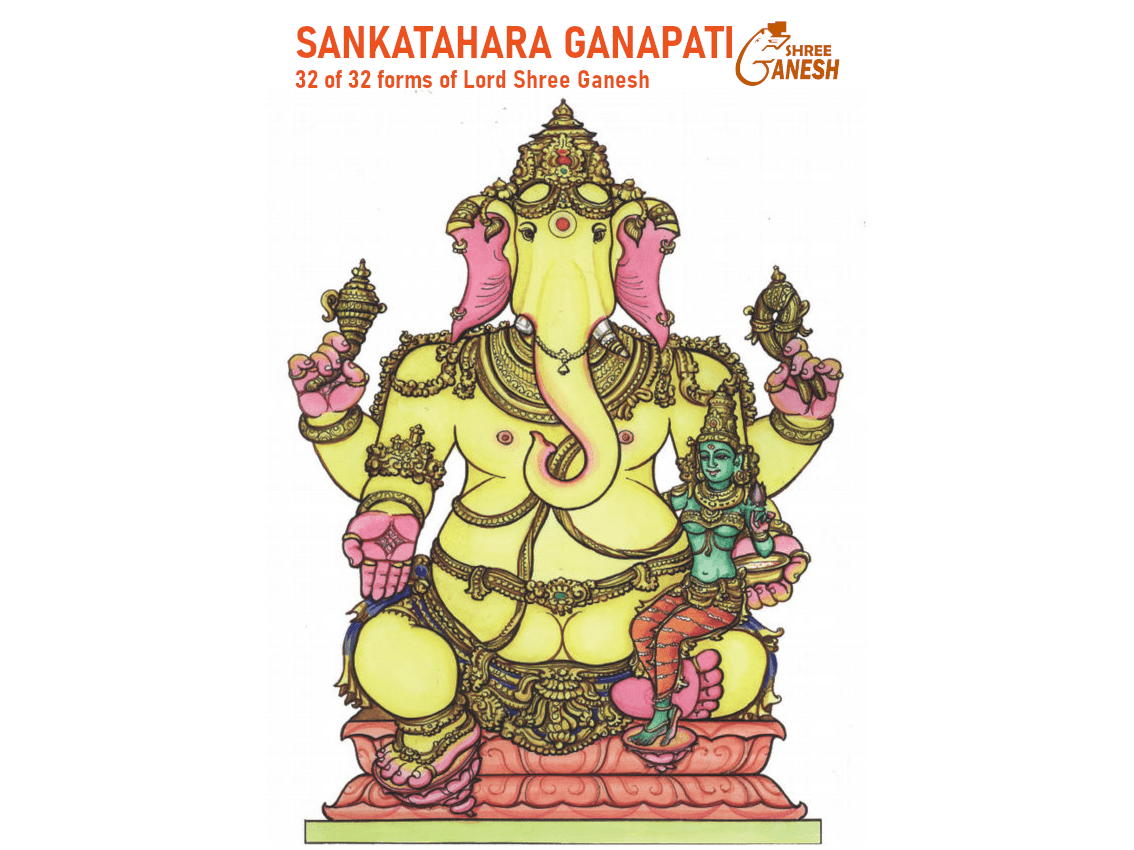
Sankatahara Ganapati: The Dispeller of Sorrow
About Lord Ganesha