
Vighna Ganapati: The Lord of Obstacles
On this page
Introduction
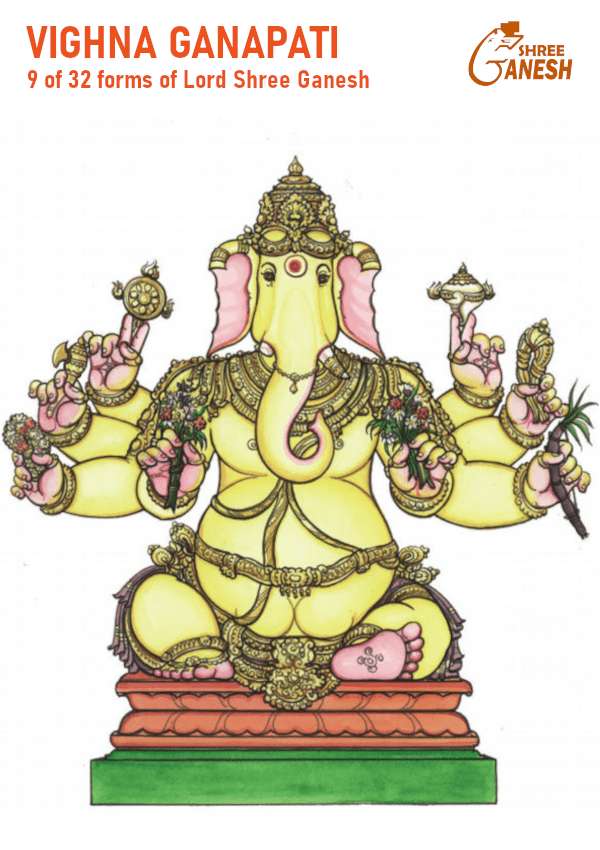
Vighna Ganapati (विघ्न गणपति) is the 9th of the 32 forms of Lord Ganesha. Vighna Ganapati, “Lord of Obstacles,” is of brilliant gold hue and bedecked in jewels. His eight arms hold a noose and goad, his tusk, a conch and discus, a sugarcane bow, flower arrows, an axe and a spray of flowers.
Vighna means obstacle. One of Ganesha’s best-known names is Vighneshvara, “Lord of Obstacles,” and he is also called Vighnaraja, “King of Obstacles,” and Vighnaharta, “Remover of Obstacles.” As their Lord he has power over obstacles both ways: he clears them from the path of the sincere, and he can set them before what should not go ahead. That is why he is worshipped first, before any other god and before any undertaking.
The 32 forms are listed in the Mudgala Purana, and their meditation verses and paintings are preserved in the Sritattvanidhi, a nineteenth-century treatise from the court of Mysore. This article looks at how Vighna Ganapati is described there, and what his form means.
The Form of Vighna Ganapati
Golden as refined gold
His meditation verse calls him tapanīya-gaura, bright as gold refined in the fire. Gold that has passed through fire is pure, and the image suits a Lord who has met every obstacle and come through it shining.
Bedecked in jewels
The verse says his splendour is that of his ornaments, bhūṣaṇa-śrī. Vighna Ganapati is shown richly adorned, as a king. The obstacles of the world are his to rule.
Victorious
The verse says simply vighneśvaro vijayate, “the Lord of Obstacles is victorious.” This form is Ganesha triumphant: the one before whom every obstacle gives way.
Eight Arms and What They Hold
Vighna Ganapati has eight arms. The meditation verse names what they hold:
- A conch (shankha), whose sound announces victory and drives away what is harmful. It is also one of the emblems of Vishnu.
- A sugarcane bow (ikshu chapa) and flower arrows (kusumeshu). They are the bow and arrows of Kama, the god of love, carried also by Maha Ganapati and the goddess Lalita. In Ganesha’s hands they stand for desire mastered and turned toward the good.
- An axe (kuthara), to cut through attachment and ignorance.
- A noose (pasha), to draw the devotee close and to bind what would harm them.
- A discus (chakra), Vishnu’s weapon, for the power that cuts through every obstacle and keeps the world in order.
- His own tusk (svadanta), the sign of sacrifice. Hindu tradition tells how Ganesha broke it off to write the Mahabharata as the sage Vyasa recited it.
- A goad (srini or ankusha), to spur the devotee onward, as a mahout guides an elephant.
- A spray of flowers (manjari), held in his hands like the rest; some descriptions place it in his trunk.
Older versions of this article, and some other descriptions, give him a modaka and a plain stalk of sugarcane. The verse names neither: the sugarcane is a bow, and with it come the flower arrows. The verse also ends its list with ādyaiḥ, “and the rest,” and some translators read its last word, śara, as a further arrow.
The Meditation Verse
The Sritattvanidhi gives this dhyana shloka for Vighna Ganapati:
शङ्खेक्षुचापकुसुमेषुकुठारपाशचक्रस्वदन्तसृणिमञ्जरिकाशराद्यैः ।
पाणिश्रितैः परिसमीहितभूषणश्रीर्विघ्नेश्वरो विजयते तपनीयगौरः ॥
śaṅkhekṣucāpakusumeṣukuṭhārapāśacakrasvadantasṛṇimañjarikāśarādyaiḥ / pāṇiśritaiḥ parisamīhitabhūṣaṇaśrīr vighneśvaro vijayate tapanīyagauraḥ
In English: “Victory to the Lord of Obstacles, bright as refined gold, splendid with his ornaments, who holds in his hands a conch, a sugarcane bow, flower arrows, an axe, a noose, a discus, his own tusk, a goad, a spray of flowers and arrows.”
Vighneshvara of Ozar
At Ozar in Maharashtra stands the Vighneshvara temple, one of the eight Ashtavinayaka shrines. Its tradition tells how Ganesha came to bear this name.
King Abhinandana once performed a great sacrifice without making an offering to Indra. Angered, Indra sent Kala, Time, in the form of the demon Vighnasura, to ruin it. Vighnasura destroyed the sacrifice, and then went on to spoil the good works and sacrifices of sages everywhere. The sages prayed for help and were told to worship Ganesha. Ganesha fought the demon, and Vighnasura, seeing that he could not win, surrendered. He promised to trouble no one, and to go only where Ganesha is not worshipped. Then he asked one thing: that Ganesha take his name, and be called Vighneshvara, Lord of Vighna, in memory of the day. The sages set up an image of Ganesha at Ozar under that name.
The story shows the meaning of the name. The obstacle is not destroyed but brought under Ganesha’s rule, and where he is worshipped it has no power. You can read more about the temple in Shree Vighnahar Ganapati Temple, Ozar.
The Significance of Vighna Ganapati
Hindus pray to Ganesha before any new undertaking, a journey, a wedding, a new home or a new piece of work, and Vighna Ganapati is that worship given a form. Devotees turn to him to clear difficulties from the way, to free the mind from troubling thoughts, and to see their work reach a good end.
His eight weapons show that he meets obstacles of every kind. Some cut, some bind, some guide and some draw near; the sugarcane bow and flower arrows even turn desire, the most stubborn obstacle of all, to good. And his tusk reminds devotees that getting past an obstacle can ask for some sacrifice.
He is one of the first sixteen forms, the Shodasha Ganapati. As Loving Ganesha records, these sixteen are installed in an eight-sided, chariot-shaped shrine at the Shri Shankara Mandapam in Rameshvaram, South India, established by Shri Chandrasekharendra Saraswati, the 68th head of the Kanchi Kamakoti Pitham.
The 32 forms, Vighna Ganapati among them, are carved in stone at the Srikanteshvara temple in Nanjangud and the Chamarajeshvara temple in Chamarajanagar, both in Karnataka, and in the Pazhavangadi Ganapathy temple in Thiruvananthapuram, Kerala.
Conclusion
Vighna Ganapati, golden as refined gold and bright with jewels, holds eight weapons and a spray of flowers. He is the Lord of Obstacles, who rules them, removes them, and sets them in the way of what should not go ahead. Worshipped first, he clears the path for everything that follows.
Frequently asked questions
- Who is Vighna Ganapati?
Vighna Ganapati (विघ्न गणपति) is the 9th of the 32 forms of Lord Ganesha, the “Lord of Obstacles,” of brilliant gold hue, bedecked in jewels and eight-armed.
- What does Vighna mean?
Vighna means obstacle. As Vighneshvara, Lord of Obstacles, Ganesha has power over them: he removes them from the path of the sincere and can place them before what should not go ahead.
- What does Vighna Ganapati hold?
His meditation verse names a conch, a sugarcane bow, flower arrows, an axe, a noose, a discus, his own tusk, a goad and a spray of flowers; some descriptions place the flowers in his trunk.
- Does Vighna Ganapati hold a modaka?
Some descriptions give him a modaka, but his meditation verse does not name one; it names his tusk among the eight things he holds.
- What is the story of Vighnasura?
In the tradition of the Ozar temple, Ganesha defeated the demon Vighnasura, who surrendered and asked that Ganesha take the name Vighneshvara, Lord of Obstacles, in memory of the event.
- Why do devotees worship Vighna Ganapati?
Devotees pray to him before any new undertaking, so that obstacles are cleared from the way and the work reaches a good end.
Continue reading
About Lord Ganesha →
About Lord Ganesha
Pray to Lord Ganesha Online
About Lord Ganesha
Sankatahara Ganapati: The Dispeller of Sorrow
About Lord Ganesha