Vijaya Ganapati: The Victorious
On this page
Introduction
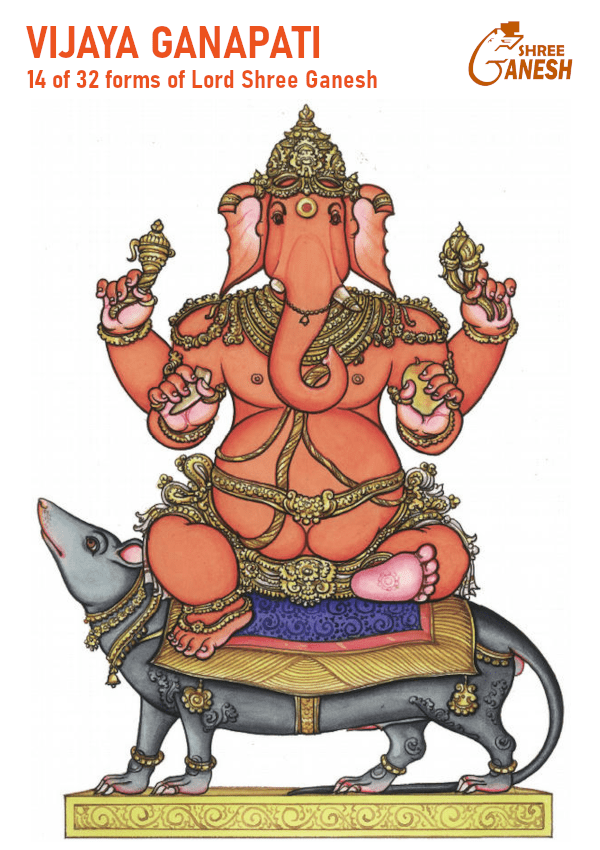
Vijaya Ganapati (विजय गणपति) is the 14th of the 32 forms of Lord Ganesha. Four-armed, of red hue and riding his resourceful mushika, Vijaya Ganapati is “the Victorious” bestower of success. His emblems are the broken tusk, the elephant goad, the noose and a golden mango.
Vijaya means “victory.” This is Ganesha as the one who brings an undertaking to a successful end, by removing whatever stands in its way.
The 32 forms are listed in the Mudgala Purana, and their meditation verses and paintings are preserved in the Sritattvanidhi, a nineteenth-century treatise from the court of Mysore.
The Form of Vijaya Ganapati
Red
His meditation verse calls him raktavarṇa, red in colour. Red in Ganesha’s forms is the colour of energy and action: victory is won by effort.
The mouse
Vijaya Ganapati rides a mouse, ākhu in the verse, Ganesha’s usual mount, also called Mushika. Descriptions of this form picture the mouse trotting at a brisk pace. Small and quick, the mouse can slip through any gap and find its way anywhere, as Ganesha finds a way past every obstacle. That the great Lord rides so small a creature also shows that victory belongs not only to the strong but to the clever and the persistent. You can read how the mouse came to carry Ganesha in the story of Ganesha and the mouse.
Four Arms and What They Hold
Vijaya Ganapati has four arms. They hold:
- His own tusk (svadanta), broken off, the sign of sacrifice: no victory comes without giving something of oneself.
- An elephant goad (ankusha), to spur the devotee onward and keep the mind on its goal.
- A noose (pasha), to draw the devotee close and hold back what would pull them off course.
- A mango (amraphala), ripe and golden, his favourite fruit and the sweet fruit of effort: the reward that victory brings.
The Meditation Verse
The Sritattvanidhi gives this short dhyana shloka for Vijaya Ganapati:
पाशाङ्कुशस्वदन्ताम्रफलवानाखुवाहनः ।
विघ्नं निहन्तु नः सर्वं रक्तवर्णो विनायकः ॥
pāśāṅkuśa-svadantāmra-phalavān ākhuvāhanaḥ / vighnaṃ nihantu naḥ sarvaṃ raktavarṇo vināyakaḥ
In English: “May the red Vinayaka, who rides a mouse and holds a noose, a goad, his own tusk and a mango, destroy all our obstacles.”
The Mango and the Race Around the World
The mango in his hand recalls one of the best-loved stories of Ganesha. Shiva and Parvati promised a divine fruit to whichever of their sons, Ganesha or Kartikeya, first went around the world. Kartikeya set off at once on his peacock. Ganesha walked around his parents, saying that they were his whole world, and won the fruit. In Loving Ganesha, Ganesha says of the mango: “It was given to Me from Lord Siva’s own hand after performing My first wisdom act. It represents the highest spiritual fruition.” It is the story of a victory won not by speed or strength but by wisdom and devotion. You can read it in Ganesh and Kartik: A Mythical Race Around the World.
The Significance of Vijaya Ganapati
Devotees turn to Vijaya Ganapati when they set out on something and want to see it through: an exam, a new venture, a difficult task. His verse is a simple prayer that he destroy every obstacle. His tusk, goad and noose stand for the sacrifice, focus and restraint that success asks for, and his mango for the sweetness of the reward.
He is one of the first sixteen forms, the Shodasha Ganapati. As Loving Ganesha records, these sixteen are installed in an eight-sided, chariot-shaped shrine at the Shri Shankara Mandapam in Rameshvaram, South India, established by Shri Chandrasekharendra Saraswati, the 68th head of the Kanchi Kamakoti Pitham.
The 32 forms, Vijaya Ganapati among them, are carved in stone at the Srikanteshvara temple in Nanjangud and the Chamarajeshvara temple in Chamarajanagar, both in Karnataka, and in the Pazhavangadi Ganapathy temple in Thiruvananthapuram, Kerala.
Conclusion
Vijaya Ganapati, the Victorious, rides his quick mouse in red, with tusk, goad, noose and mango in his four hands. He is the Lord of success who clears the way, and his mango is the sweet fruit at the end of it, won, as in the story of the race, by wisdom as much as by effort.
Frequently asked questions
- Who is Vijaya Ganapati?
Vijaya Ganapati (विजय गणपति) is the 14th of the 32 forms of Lord Ganesha, “the Victorious” bestower of success, four-armed, red and riding his mouse.
- What does Vijaya mean?
Vijaya means “victory” or “the victorious.”
- What does Vijaya Ganapati hold?
His broken tusk, an elephant goad, a noose and a mango.
- Why does Vijaya Ganapati ride a mouse?
The mouse, Mushika, is Ganesha’s usual mount. Small and quick, it can slip through any gap, as Ganesha finds a way past every obstacle.
- What is the meditation verse of Vijaya Ganapati?
It begins “pāśāṅkuśa-svadantāmra-phalavān ākhuvāhanaḥ” and asks the red Vinayaka, who rides a mouse and holds a noose, goad, his tusk and a mango, to destroy all our obstacles.
- Why do devotees worship Vijaya Ganapati?
They turn to him for victory and success in what they undertake, and for the removal of every obstacle in their way.
Continue reading
About Lord Ganesha →
About Lord Ganesha
Pray to Lord Ganesha Online
About Lord Ganesha
Sankatahara Ganapati: The Dispeller of Sorrow
About Lord Ganesha