
Vira Ganapati: The Valiant Warrior Lord with Sixteen Arms
On this page
Introduction
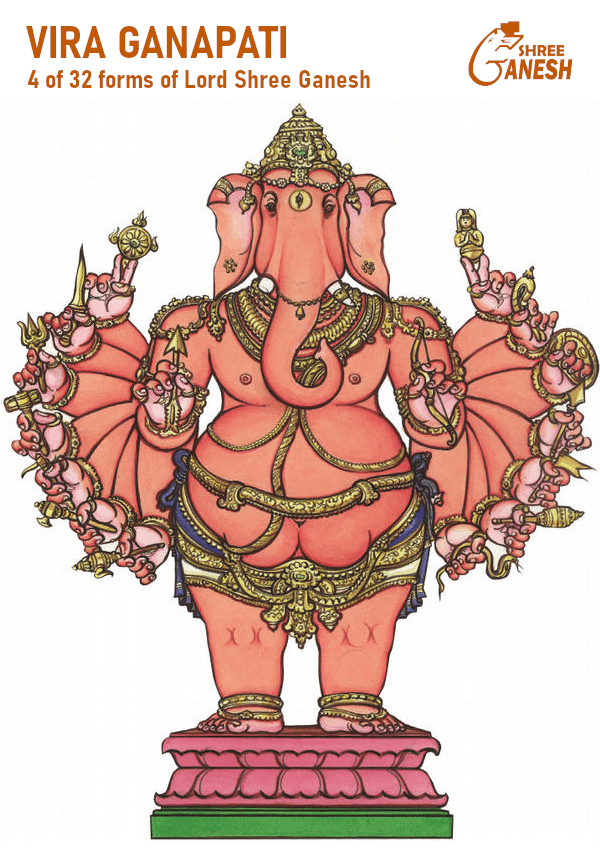
Vira Ganapati (वीर गणपति) is the fourth of the 32 forms of Lord Ganesha. The “Valiant Warrior,” Vira Ganapati, assumes a commanding pose. His sixteen arms bristle with weapons, symbols of the powers of the mind: a goad, a discus, a bow and arrow, a sword, a spear, a mace, a battle-axe, a trident and more.
Vira means “hero” or “brave warrior.” Ganesha is usually thought of as gentle, the kindly remover of obstacles, but the remover of obstacles must also be strong enough to remove them. Vira Ganapati shows that strength. He is often spelled Veera Ganapati.
The 32 forms are listed in the Mudgala Purana, and their meditation verses and paintings are preserved in the Sritattvanidhi, a nineteenth-century treatise from the court of Mysore.
The Form of Vira Ganapati
The warrior
Vira Ganapati is shown in a commanding pose, a warrior ready for battle. Of the first sixteen forms, he has the most arms, and every hand holds a weapon. Where Bala Ganapati, the first form, holds only fruit, Vira Ganapati holds an armoury.
Red
His meditation verse calls him aruṇa, red as the dawn sky. Red in Ganesha’s forms is the colour of energy, action and courage, and it suits a warrior.
Sixteen Arms and What They Hold
His meditation verse names these weapons:
- A vetala, a spirit of the cremation ground. Translators differ on whether this means such a being under his command or a weapon of that name.
- A spear (shakti), the weapon of power.
- An arrow (shara) and a bow (karmuka), for aim and focus.
- A discus (chakra), which cuts through confusion and illusion.
- A sword (khadga), which cuts through ignorance.
- A khatvanga, a staff topped with a skull, carried by Shiva and the ascetics devoted to him.
- A hammer (mudgara) and a mace (gada), for crushing what stands in the way.
- A goad (ankusha), which spurs the devotee onward, as a mahout guides an elephant.
- A serpent noose (nagapasha), which binds the mind’s wandering tendencies.
- A trident (shula), often read as mastery over the three qualities of nature, sattva, rajas and tamas.
- A lance (kunta), which pierces difficulties.
- An axe (parashu), which cuts the bonds of attachment.
- A banner (dhvaja), the flag of victory.
That is fifteen names for sixteen hands, and translators group them a little differently to fit. One printed version of the verse reads a plough in place of the banner; the version in the Mudgala Purana has the banner. A shield and a rosary, sometimes listed among his attributes, are not in the verse.
The Meditation Verse
The Sritattvanidhi gives this dhyana shloka for Vira Ganapati:
वेतालशक्तिशरकार्मुकचक्रखड्ग-
खट्वाङ्गमुद्गरगदाङ्कुशनागपाशान् ।
शूलं च कुन्तपरशुं ध्वजमुद्वहन्तं
वीरं गणेशमरुणं सततं स्मरामि ॥
vetāla-śakti-śara-kārmuka-cakra-khaḍga- / khaṭvāṅga-mudgara-gadāṅkuśa-nāgapāśān / śūlaṃ ca kunta-paraśuṃ dhvajam udvahantaṃ / vīraṃ gaṇeśam aruṇaṃ satataṃ smarāmi
In English: “I always remember the valiant Ganesha, red as the dawn, who bears a vetala, a spear, an arrow, a bow, a discus, a sword, a khatvanga staff, a hammer, a mace, a goad, a serpent noose, a trident, a lance, an axe and a banner.”
The Weapons as Powers of the Mind
The weapons of Vira Ganapati are not only for outer battles. In Hindu thought the mind is often pictured as a battlefield, where good and harmful tendencies struggle for control. Read this way, each of his weapons is a power the devotee needs: the goad of effort, the noose of self-control, the sword of discernment, the bow and arrow of concentration, the axe that cuts attachment. The enemies Vira Ganapati defeats are fear, doubt, anger and laziness as much as any outer foe.
The Significance of Vira Ganapati
Devotees turn to Vira Ganapati for courage, strength and protection in times of difficulty, and for the will to face their obstacles rather than run from them. The verse asks nothing more than to keep him in mind, satataṃ smarāmi, “I always remember”: to hold the image of the valiant Lord steadily in thought, so that his courage becomes the devotee’s own.
He is one of the first sixteen forms, the Shodasha Ganapati. As Loving Ganesha records, these sixteen are installed in an eight-sided, chariot-shaped shrine at the Shri Shankara Mandapam in Rameshvaram, South India, established by Shri Chandrasekharendra Saraswati, the 68th head of the Kanchi Kamakoti Pitham.
The 32 forms, Vira Ganapati among them, are carved in stone at the Srikanteshvara temple in Nanjangud and the Chamarajeshvara temple in Chamarajanagar, both in Karnataka, and in the Pazhavangadi Ganapathy temple in Thiruvananthapuram, Kerala.
Conclusion
Vira Ganapati, the Valiant Warrior, is red and commanding, his sixteen arms full of weapons: spear and discus, bow and arrow, sword and axe, trident and banner. He is the strength behind Ganesha’s gentleness, the power that removes obstacles. For the devotee he is courage itself, and every weapon he holds is a strength of the mind.
Frequently asked questions
- Who is Vira Ganapati?
Vira Ganapati (वीर गणपति) is the fourth of the 32 forms of Lord Ganesha, “the Valiant Warrior,” a red, sixteen-armed Ganesha in a commanding pose.
- What does Vira mean?
Vira means “hero” or “brave warrior.” Vira Ganapati is Ganesha as a fighter who defends dharma and his devotees.
- What weapons does Vira Ganapati hold?
His meditation verse names a vetala, a spear, an arrow, a bow, a discus, a sword, a khatvanga staff, a hammer, a mace, a goad, a serpent noose, a trident, a lance, an axe and a banner.
- What do Vira Ganapati’s weapons stand for?
They are read as powers of the mind: the strengths a devotee needs to overcome fear, doubt and the inner enemies that block the spiritual path.
- What colour is Vira Ganapati?
Red. His meditation verse calls him aruṇa, red as the dawn, the colour of energy and action.
- Why do devotees worship Vira Ganapati?
Devotees turn to him for courage, strength and protection in times of difficulty, and for the will to face their obstacles rather than run from them.
Continue reading
About Lord Ganesha →
About Lord Ganesha
Pray to Lord Ganesha Online
About Lord Ganesha
Sankatahara Ganapati: The Dispeller of Sorrow
About Lord Ganesha