
Dvimukha Ganapati: The Two-Faced Lord
On this page
Introduction
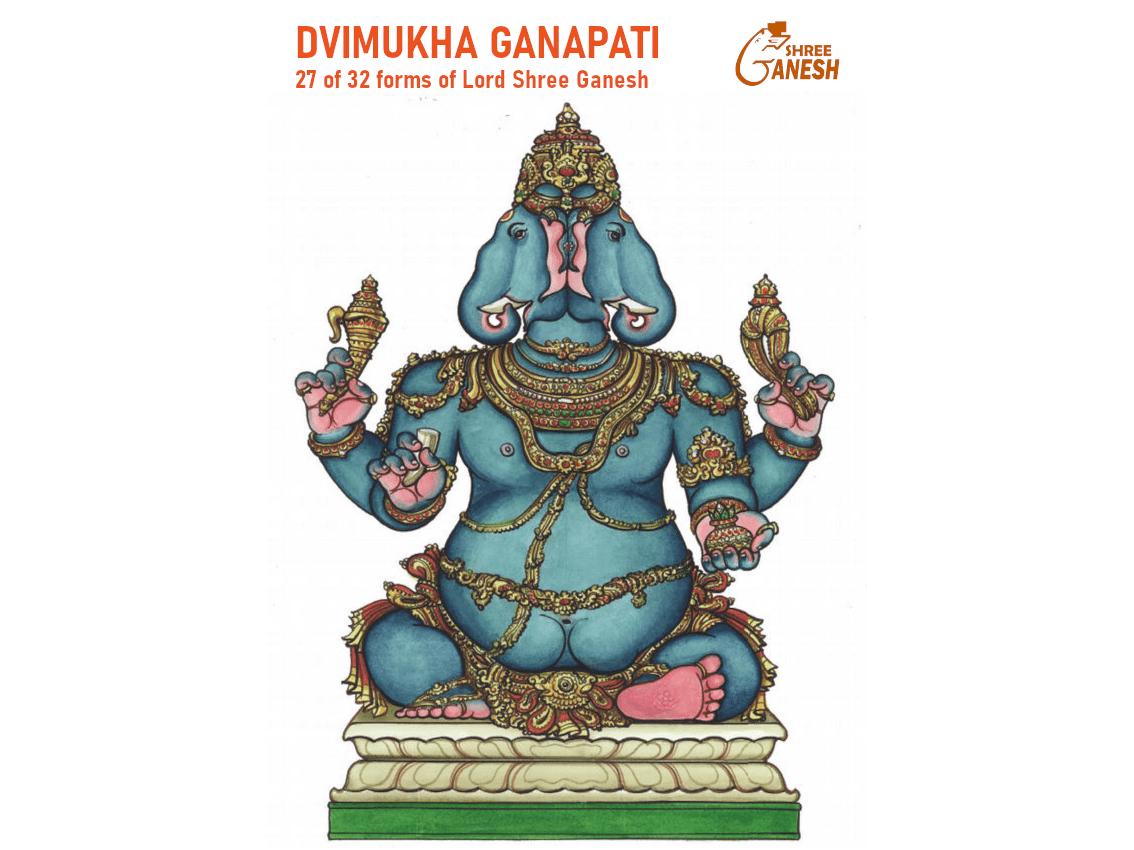
Dvimukha Ganapati (द्विमुख गणपति) is the 27th of the 32 forms of Lord Ganesha. With two divergent faces, he sees in all directions. His blue-green form is dressed in red silk. He wears a bejewelled crown and holds a noose, a goad, his tusk and a pot of gems.
His name joins dvi, two, with mukha, face. He is the first of two many-faced forms that come next to each other among the 32: Dvimukha with two faces, then Trimukha Ganapati with three.
The 32 forms are listed in the Mudgala Purana, and their meditation verses and paintings are preserved in the Sritattvanidhi, a nineteenth-century treatise from the court of Mysore.
The Form of Dvimukha Ganapati
Two faces
His two faces look in different directions, so that nothing escapes his sight. They can be read in many pairs: the world in front and the world behind, what is outside and what is within, the practical and the spiritual. Dvimukha Ganapati sees both sides of every matter at once.
Blue-green, robed in red
His meditation verse calls his body harinīla, blue-green, the colour of deep water and growing things. He is dressed in red silk, the colour of energy, and wears a crown and garland of jewels: he is a Lord of splendour and authority.
Four Hands and What They Hold
- A noose (pasha), to draw devotees close and hold them on the right path.
- A goad (ankusha), to spur them onward.
- His own tusk (svadanta), the sign of sacrifice.
- A pot of gems (ratnapatra), the riches he keeps for his devotees, inner and outer.
The Meditation Verse
स्वदन्तपाशाङ्कुशरत्नपात्रं करैर्दधानो हरिनीलगात्रः ।
रक्तांशुको रत्नकिरीटमाली भूत्यै सदा मे द्विमुखो गणेशः ॥
svadanta-pāśāṅkuśa-ratnapātraṃ karair dadhāno harinīla-gātraḥ / raktāṃśuko ratna-kirīṭa-mālī bhūtyai sadā me dvimukho gaṇeśaḥ
In English: “Holding in his hands his own tusk, a noose, a goad and a pot of gems, his body blue-green, clad in red, wearing a jewelled crown and garland: may two-faced Ganesha always be for my prosperity.”
The Significance of Dvimukha Ganapati
Devotees turn to Dvimukha Ganapati for clear sight and good judgement: the ability to look at a situation from both sides before acting. His two faces are a reminder that worldly life and spiritual life need not pull apart; the wise person attends to both. His verse asks that he be bhūtyai sadā, always for our prosperity and well-being.
The 32 forms, Dvimukha Ganapati among them, are carved in stone at the Srikanteshvara temple in Nanjangud and the Chamarajeshvara temple in Chamarajanagar, both in Karnataka, and in the Pazhavangadi Ganapathy temple in Thiruvananthapuram, Kerala.
Conclusion
Dvimukha Ganapati, blue-green and crowned with jewels, looks two ways at once. With noose and goad he guides, with his tusk he teaches sacrifice, and with his pot of gems he gives. To his devotees he offers the gift of his two faces: seeing clearly, in every direction.
Frequently asked questions
- Who is Dvimukha Ganapati?
Dvimukha Ganapati (द्विमुख गणपति) is the 27th of the 32 forms of Lord Ganesha, with two divergent faces that see in all directions.
- What does Dvimukha mean?
Dvimukha means “two-faced,” from dvi, two, and mukha, face.
- What does Dvimukha Ganapati hold?
His four hands hold a noose, a goad, his tusk and a pot of gems.
- What colour is Dvimukha Ganapati?
His form is blue-green, dressed in red silk, and he wears a bejewelled crown.
- What do the two faces stand for?
Seeing both sides of every matter: the outer world and the inner, the practical and the spiritual, looked at together.
Continue reading
About Lord Ganesha →
About Lord Ganesha
Pray to Lord Ganesha Online
About Lord Ganesha
Sankatahara Ganapati: The Dispeller of Sorrow
About Lord Ganesha