
Heramba Ganapati: The Protector of the Weak
On this page
Introduction
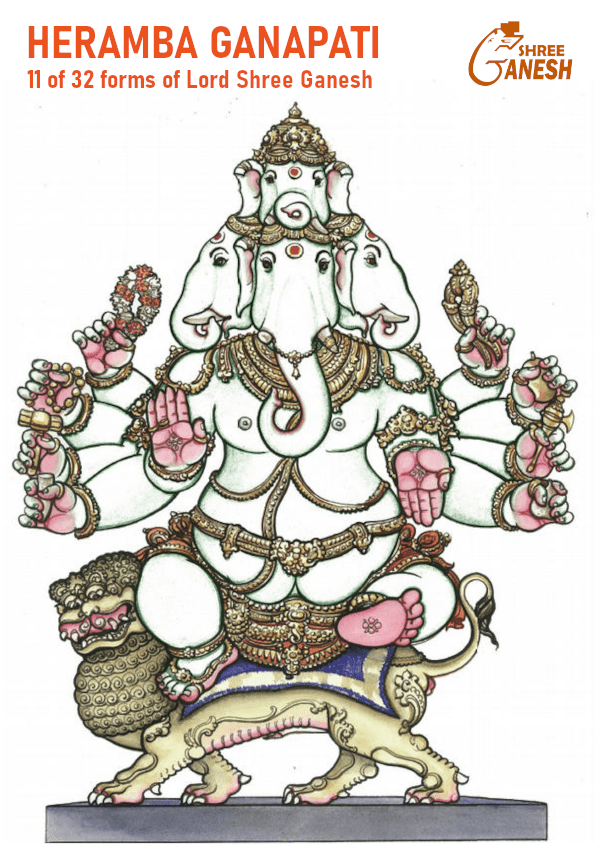
Heramba Ganapati (हेरम्ब गणपति) is the 11th of the 32 forms of Lord Ganesha. Five-faced and white in colour, Heramba Ganapati, “Protector of the Weak,” rides a great lion. He gives the gestures of protection and blessing, and holds a noose, a rosary, an axe, a hammer, his tusk, a fruit and a modaka sweet.
The Brahma Vaivarta Purana explains the name. The syllable he stands for helplessness or weakness, and ramba for protecting the weak and saving them from harm: so Heramba is the protector of the weak and the good. Heramba is also one of Ganesha’s names in the Puranas, among them the Mudgala, Skanda, Ganesha and Brahma Vaivarta Puranas.
The 32 forms are listed in the Mudgala Purana, and their meditation verses and paintings are preserved in the Sritattvanidhi, a nineteenth-century treatise from the court of Mysore.
The Form of Heramba Ganapati
Five faces
Heramba Ganapati has five elephant faces. Four look out to the four directions and the fifth looks upward, though paintings often show four faces in a row with the fifth above them. Five-faced forms are rare among the 32. The faces are often read as the five elements, earth, water, fire, air and space, or simply as a Lord who watches over his devotees on every side.
Very fair
His meditation verse calls him atigaura, “very fair,” and he is shown white or pale gold. White is the colour of purity and calm: his strength is never out of control.
The lion
Where Ganesha usually rides a mouse, Heramba rides a lion. The lion is the king of beasts, and it shows the royal and fearless strength with which Heramba defends those who cannot defend themselves. He is not the only lion-riding Ganesha: in the Ganesha Purana, Mahotkata Vinayaka rides one too, and Simha Ganapati, the 29th of the 32 forms, is bound up with the lion’s strength.
Ten Arms and What They Hold
Heramba Ganapati has ten arms. Two of his hands make gestures, and the other eight hold:
- The gesture of fearlessness (abhaya mudra), the open hand raised to say “do not fear.”
- The boon-giving gesture (varada mudra), the open hand turned down, granting wishes.
- A noose (pasha), to draw his devotees close and hold back what would harm them.
- His tusk (danta), the sign of sacrifice.
- A rosary (akshamala), for prayer and japa, the repetition of a mantra.
- A goad (srini), to spur the devotee onward, as a mahout guides an elephant.
- An axe (parashu), to cut the bonds of ignorance and attachment.
- A hammer or mallet (mudgara), to break down obstacles.
- A modaka, the sweet that stands for the joy of spiritual life.
- A fruit (phala), the fruit of devotion and effort. Some writers name it as a citron.
The well-known modern description of this form lists a garland among his items and leaves out the goad. The meditation verse names a goad and no garland, and this list follows the verse.
The Meditation Verse
The Sritattvanidhi gives this dhyana shloka for Heramba Ganapati:
अभयवरदहस्तः पाशदन्ताक्षमाला-
सृणिपरशु दधानो मुद्गरं मोदकं च ।
फलमधिगतसिंहः पञ्चमातङ्गवक्त्रो
गणपतिरतिगौरः पातु हेरम्बनामा ॥
abhayavaradahastaḥ pāśadantākṣamālā- / sṛṇiparaśu dadhāno mudgaraṃ modakaṃ ca / phalam adhigatasiṃhaḥ pañcamātaṅgavaktro / gaṇapatir atigauraḥ pātu herambanāmā
In English: “May the Ganapati named Heramba protect us: he whose hands give fearlessness and boons, who holds a noose, his tusk, a rosary, a goad, an axe, a hammer, a modaka and a fruit; who is mounted on a lion, has five elephant faces, and is very fair.”
Heramba in Nepal
Heramba is especially popular in Nepal, where the five-headed Ganesha riding a lion is a familiar form in sculpture and painting, including many works from the eighteenth century. Nepalese images often show his mouse as well as his lion. Heramba is also important in the Tantric worship of Ganesha. You can read about some of the Ganesha temples of Nepal in Four Ganesh Temples in Kathmandu Valley.
The Significance of Heramba Ganapati
The verse ends with a plain prayer: pātu, “may he protect.” Heramba Ganapati is the form devotees turn to when they feel weak, alone or afraid. His five faces watch on every side, his lion carries him swiftly to those in need, and his raised hand says “do not fear.” His weapons, the axe, the hammer and the goad, are turned against what harms his devotees, and his beads, fruit and sweet show the reward of a life of prayer.
He is one of the first sixteen forms, the Shodasha Ganapati. As Loving Ganesha records, these sixteen are installed in an eight-sided, chariot-shaped shrine at the Shri Shankara Mandapam in Rameshvaram, South India, established by Shri Chandrasekharendra Saraswati, the 68th head of the Kanchi Kamakoti Pitham.
The 32 forms, Heramba Ganapati among them, are carved in stone at the Srikanteshvara temple in Nanjangud and the Chamarajeshvara temple in Chamarajanagar, both in Karnataka, and in the Pazhavangadi Ganapathy temple in Thiruvananthapuram, Kerala.
Conclusion
Heramba Ganapati, five-faced and very fair, rides his lion as the Protector of the Weak. With ten arms he holds the weapons that guard his devotees and the gifts that sweeten their lives, and with his open hands he gives boons and takes away fear.
Frequently asked questions
- Who is Heramba Ganapati?
Heramba Ganapati (हेरम्ब गणपति) is the 11th of the 32 forms of Lord Ganesha, the five-faced, very fair “Protector of the Weak,” who rides a lion.
- What does Heramba mean?
The Brahma Vaivarta Purana explains that the syllable he stands for helplessness or weakness, and ramba for protecting the weak, so Heramba is the protector of the weak.
- What does Heramba Ganapati hold?
He has ten arms. Two give the gestures of fearlessness and blessing; the others hold a noose, his tusk, a rosary, a goad, an axe, a hammer, a modaka and a fruit.
- Why does Heramba Ganapati ride a lion?
The lion, king of beasts, shows the royal and fearless strength with which he defends those who cannot defend themselves.
- Where is Heramba Ganapati especially popular?
In Nepal, where the five-headed Heramba riding a lion is a familiar form of Ganesha in sculpture and painting.
- Why do devotees worship Heramba Ganapati?
His meditation verse asks him to protect us, and devotees turn to him for protection and courage when they feel weak or alone.
Continue reading
About Lord Ganesha →
About Lord Ganesha
Pray to Lord Ganesha Online
About Lord Ganesha
Sankatahara Ganapati: The Dispeller of Sorrow
About Lord Ganesha