
Kshipra Ganapati: The Quick-Acting Bestower of Boons
On this page
Introduction
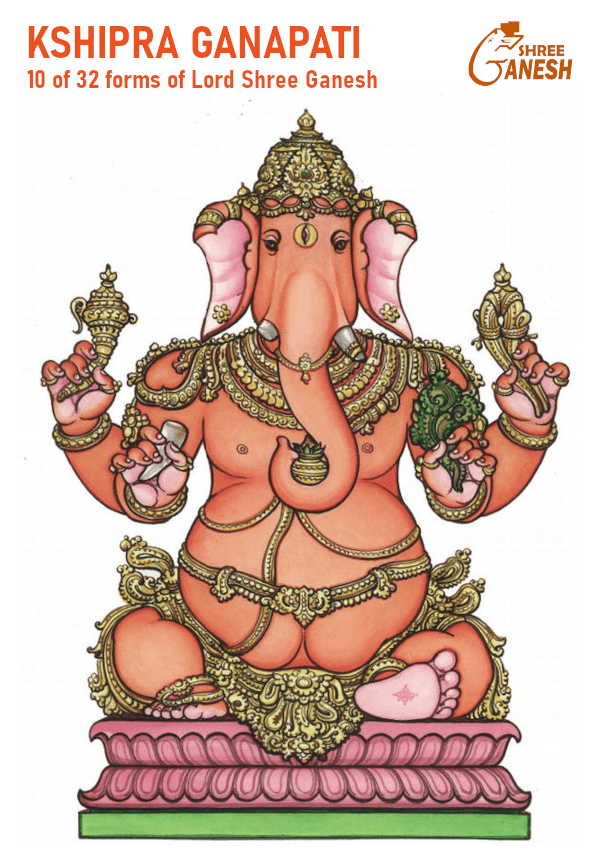
Kshipra Ganapati (क्षिप्र गणपति) is the 10th of the 32 forms of Lord Ganesha. Handsome and red-hued, Kshipra Ganapati, the “Quick-Acting” giver of boons, displays his broken tusk, a noose, a goad and a sprig of the kalpavriksha, the wish-fulfilling tree. In his uplifted trunk he holds a tiny pot of precious jewels.
Kshipra means quick or swift. He is the Lord who is easily pleased and does not keep his devotees waiting: what is asked of him with a sincere heart, he grants quickly.
The 32 forms are listed in the Mudgala Purana, and their meditation verses and paintings are preserved in the Sritattvanidhi, a nineteenth-century treatise from the court of Mysore. This article looks at how Kshipra Ganapati is described there, and what his form means.
The Form of Kshipra Ganapati
Red as the bandhuka flower
His meditation verse says his lustre is lovely as the bandhuka, a flower of bright red that blooms at midday and is often offered in worship. Red is the colour of energy and action, fitting for a Lord who acts quickly.
Handsome and shining
The verse calls him kamanīya, lovely to see, and ujjvala, shining with what he holds. Kshipra Ganapati is one of the gentlest and most pleasing of the 32 forms, a Lord to whom it is easy to turn.
The pot of jewels
In his raised trunk he carries a small pot full of precious gems, the ratna kumbha. Where other forms hold a sweet in the trunk, Kshipra Ganapati holds treasure: the riches, worldly and spiritual, that he is ready to give.
Four Arms and What They Hold
Kshipra Ganapati has four arms, and holds a fifth thing in his trunk.
- His own tusk (danta), the broken tusk, the sign of sacrifice and of letting go of pride.
- A sprig of the wish-fulfilling tree (kalpalata). In the verse it is the kalpalata, the wish-fulfilling creeper that grows with the kalpavriksha, the tree of heaven that grants whatever is asked of it. It is the heart of this form: the power to fulfil wishes.
- A noose (pasha), to draw the devotee close and hold back what would pull them away.
- A goad (ankusha), to spur the devotee onward on the right path.
- A pot of precious jewels (ratna kumbha), held in his trunk, for the abundance he gives.
The Meditation Verse
The Sritattvanidhi gives this dhyana shloka for Kshipra Ganapati:
दन्तकल्पलतापाशरत्नकुम्भाङ्कुशोज्ज्वलम् ।
बन्धूककमनीयाभं ध्यायेत् क्षिप्रगणाधिपम् ॥
dantakalpalatāpāśaratnakumbhāṅkuśojjvalam / bandhūkakamanīyābhaṃ dhyāyet kṣipragaṇādhipam
In English: “One should meditate on Kshipra, Lord of the ganas, shining with his tusk, the wish-fulfilling creeper, the noose, the pot of jewels and the goad, his lustre lovely as the bandhuka flower.”
Kshipra and Kshipra Prasada
Two of the 32 forms carry the word kshipra. Kshipra Ganapati, the 10th, is the quick-acting giver of boons, four-armed, with his pot of jewels. Kshipra Prasada Ganapati, the 20th, is “the Quick Rewarder,” the Lord quick to give prasada, his grace. He has six arms and sits on a throne of kusha grass, and besides the noose, goad, tusk and wish-fulfilling sprig that Kshipra Ganapati also holds, he carries a lotus and a fruit.
The two are separate forms with separate meditation verses. One is quick to grant what is asked; the other quick to give his grace.
The Significance of Kshipra Ganapati
Devotees turn to Kshipra Ganapati when they need help quickly: in a time of trouble, before an important decision, or when a sincere wish has long gone unanswered. They worship him for the swift fulfilment of their wishes, and tradition holds that he is easily pleased and promptly grants what is asked.
His form shows how he gives. The noose and goad keep the devotee close and moving forward, the tusk asks them to let go of pride, and the wish-fulfilling sprig and the pot of jewels are the answer waiting for them. His quickness is not haste but readiness: the Lord does not hold back what a devotee truly needs.
He is one of the first sixteen forms, the Shodasha Ganapati. As Loving Ganesha records, these sixteen are installed in an eight-sided, chariot-shaped shrine at the Shri Shankara Mandapam in Rameshvaram, South India, established by Shri Chandrasekharendra Saraswati, the 68th head of the Kanchi Kamakoti Pitham.
The 32 forms, Kshipra Ganapati among them, are carved in stone at the Srikanteshvara temple in Nanjangud and the Chamarajeshvara temple in Chamarajanagar, both in Karnataka, and in the Pazhavangadi Ganapathy temple in Thiruvananthapuram, Kerala.
Conclusion
Kshipra Ganapati, red as the bandhuka flower, holds his tusk, noose, goad and the sprig of the wish-fulfilling tree, and lifts a pot of jewels in his trunk. He is the quick-acting giver of boons, easily pleased and swift to answer, and a reminder that help is always near for those who turn to him.
Frequently asked questions
- Who is Kshipra Ganapati?
Kshipra Ganapati (क्षिप्र गणपति) is the 10th of the 32 forms of Lord Ganesha, the handsome, red-hued, quick-acting giver of boons.
- What does Kshipra mean?
Kshipra means quick or swift: he is the Lord who is easily pleased and quick to grant what his devotees ask.
- What does Kshipra Ganapati hold?
His four hands hold his broken tusk, a noose, a goad and a sprig of the wish-fulfilling tree, and in his raised trunk he holds a small pot of precious jewels.
- What is the kalpalata?
The kalpalata is the wish-fulfilling creeper, the companion of the kalpavriksha, the wish-fulfilling tree of heaven that grants whatever is asked of it.
- What colour is Kshipra Ganapati?
He is red, and his meditation verse compares him to the bandhuka, a flower of bright red.
- Is Kshipra Ganapati the same as Kshipra Prasada Ganapati?
No. Kshipra Ganapati, the 10th form, is the quick-acting giver of boons with four arms and a pot of jewels; Kshipra Prasada Ganapati, the 20th, is the six-armed Lord quick to give his grace, seated on a kusha-grass throne.
Continue reading
About Lord Ganesha →
About Lord Ganesha
Pray to Lord Ganesha Online
About Lord Ganesha
Sankatahara Ganapati: The Dispeller of Sorrow
About Lord Ganesha