
Kshipra Prasada Ganapati: The Quick Rewarder
On this page
Introduction
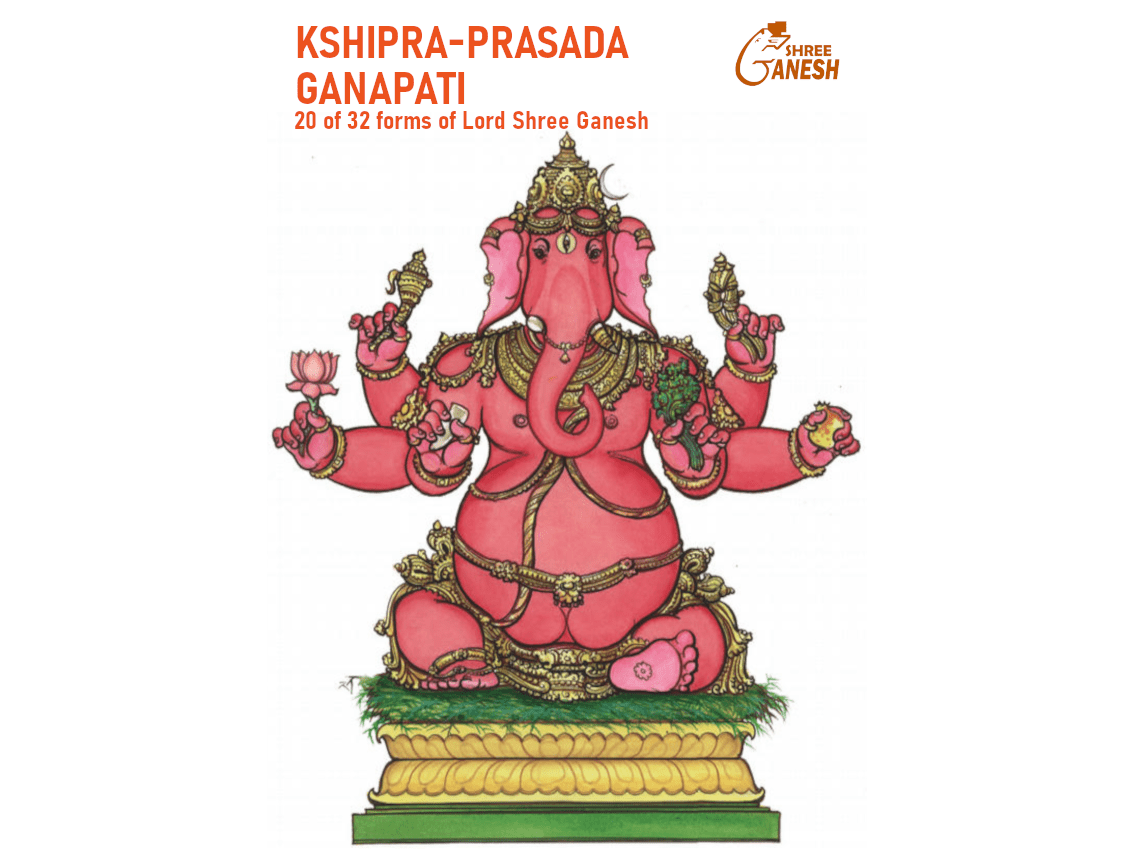
Kshipra Prasada Ganapati (क्षिप्रप्रसाद गणपति) is the 20th of the 32 forms of Lord Ganesha. He is “the Quick Rewarder,” who presides from a throne of kusha grass. His big belly symbolizes the manifest universe. He holds a noose, a goad, his tusk, a lotus, a pomegranate and a twig of the wish-fulfilling tree.
His name joins kshipra, quick, with prasada, grace or favour. He is the Lord who does not keep his devotees waiting: when they pray sincerely, his grace comes swiftly.
The 32 forms are listed in the Mudgala Purana, and their meditation verses and paintings are preserved in the Sritattvanidhi, a nineteenth-century treatise from the court of Mysore.
Two Quick Forms
Kshipra Prasada Ganapati is not the same form as Kshipra Ganapati, the 10th of the 32. Both carry the word kshipra, quick. Kshipra Ganapati is the quick-acting giver of boons, holding a pot of jewels in his trunk. Kshipra Prasada Ganapati is the one quick to give prasada, his grace: the blessing that, in Hindu worship, also names the food offered to the deity and then shared with devotees as his gift.
The Form of Kshipra Prasada Ganapati
Red, three-eyed and crowned with the moon
His meditation verse describes him as red (aruna), three-eyed, with a crescent moon in his crown and shining ornaments. Red is the colour of energy and action, fitting for a Lord who acts quickly. The third eye is the eye of wisdom, and the crescent moon links him to his father Shiva, who wears it too.
The kusha-grass throne
He sits on a throne of kusha, the sacred grass used in Vedic ritual. Priests make seats and rings of it, and it is held to purify whatever it touches. In the verse he is also seated on a broad, spreading lotus.
The big belly
His big belly symbolizes the manifest universe. Ganesha is Lambodara, “the pot-bellied,” and the whole of creation is said to be held within him.
Six Arms and What They Hold
- A noose (pasha), to draw devotees close.
- A goad (ankusha), to spur them onward on the right path.
- His own tusk (svadanta), the sign of Ganesha’s sacrifice.
- A twig of the kalpavriksha, the wish-fulfilling tree of heaven, which grants whatever is asked of it. In the verse this is the kalpalata, its creeper.
- A bijapura fruit, literally a citron, often rendered as a pomegranate: a fruit full of seeds, the many blessings in one gift.
- A lotus, for purity and spiritual unfolding.
The Meditation Verse
The Sritattvanidhi gives this dhyana shloka for Kshipra Prasada Ganapati:
धृतपाशाङ्कुशकल्पलतास्वरदश्च बीजपूरयुतः ।
शशिशकलकलितमौलिस्त्रिलोचनोऽरुणश्च गजवदनः ।
भासुरभूषणदीप्तो बृहदुदरः पद्मविष्टरोल्लसितः ।
विघ्नपयोधरपवनः करधृतकमलः सदास्तु मे भूत्यै ॥
dhṛta-pāśāṅkuśa-kalpalatā-svaradaś ca bījapūra-yutaḥ / śaśi-śakala-kalita-maulis trilocano ’ruṇaś ca gajavadanaḥ / bhāsura-bhūṣaṇa-dīpto bṛhad-udaraḥ padma-viṣṭarollasitaḥ / vighna-payodhara-pavanaḥ kara-dhṛta-kamalaḥ sadāstu me bhūtyai
In English: “Holding the noose, the goad, the wish-fulfilling creeper and his own tusk, with a citron; a crescent moon in his crown, three-eyed, red, elephant-faced; bright with shining ornaments, great-bellied, resplendent on a spreading lotus seat; the wind that drives away the clouds of obstacles, a lotus in his hand: may he be always for my prosperity.”
The Significance of Kshipra Prasada Ganapati
Devotees turn to Kshipra Prasada Ganapati for the quick fulfilment of their prayers, and for his grace in whatever they undertake. The verse’s image of him as the wind that drives away the clouds of obstacles says it simply: as wind clears the sky, he clears the way.
Shrines to this form are found in several places. One is the Kshipra Prasad Vinayak of Varanasi, at Pitar Kund. The 32 forms, Kshipra Prasada Ganapati among them, are carved in stone at the Srikanteshvara temple in Nanjangud and the Chamarajeshvara temple in Chamarajanagar, both in Karnataka, and in the Pazhavangadi Ganapathy temple in Thiruvananthapuram, Kerala.
Conclusion
Kshipra Prasada Ganapati, red and three-eyed on his throne of sacred grass, holds the whole universe in his belly and the wish-fulfilling tree in his hand. He is the Lord whose grace comes quickly to those who turn to him, clearing their obstacles as the wind clears the clouds.
Frequently asked questions
- Who is Kshipra Prasada Ganapati?
Kshipra Prasada Ganapati (क्षिप्रप्रसाद गणपति) is the 20th of the 32 forms of Lord Ganesha, “the Quick Rewarder,” who presides from a kusha-grass throne.
- What does Kshipra Prasada mean?
Kshipra means quick and prasada means grace or favour: the Lord who is quick to give his grace.
- How is he different from Kshipra Ganapati?
They are two separate forms. Kshipra Ganapati, the 10th form, is the quick-acting giver of boons; Kshipra Prasada Ganapati, the 20th, is the one quick to bestow his grace.
- What does Kshipra Prasada Ganapati hold?
His six hands hold a noose, a goad, his own tusk, a lotus, a bijapura fruit (often rendered as pomegranate) and a twig of the wish-fulfilling tree.
- What does his big belly mean?
His big belly symbolizes the manifest universe, which is held within him.
Continue reading
About Lord Ganesha →
About Lord Ganesha
Pray to Lord Ganesha Online
About Lord Ganesha
Sankatahara Ganapati: The Dispeller of Sorrow
About Lord Ganesha