
Tryakshara Ganapati: The Tri-Syllabic Deity
On this page
Introduction
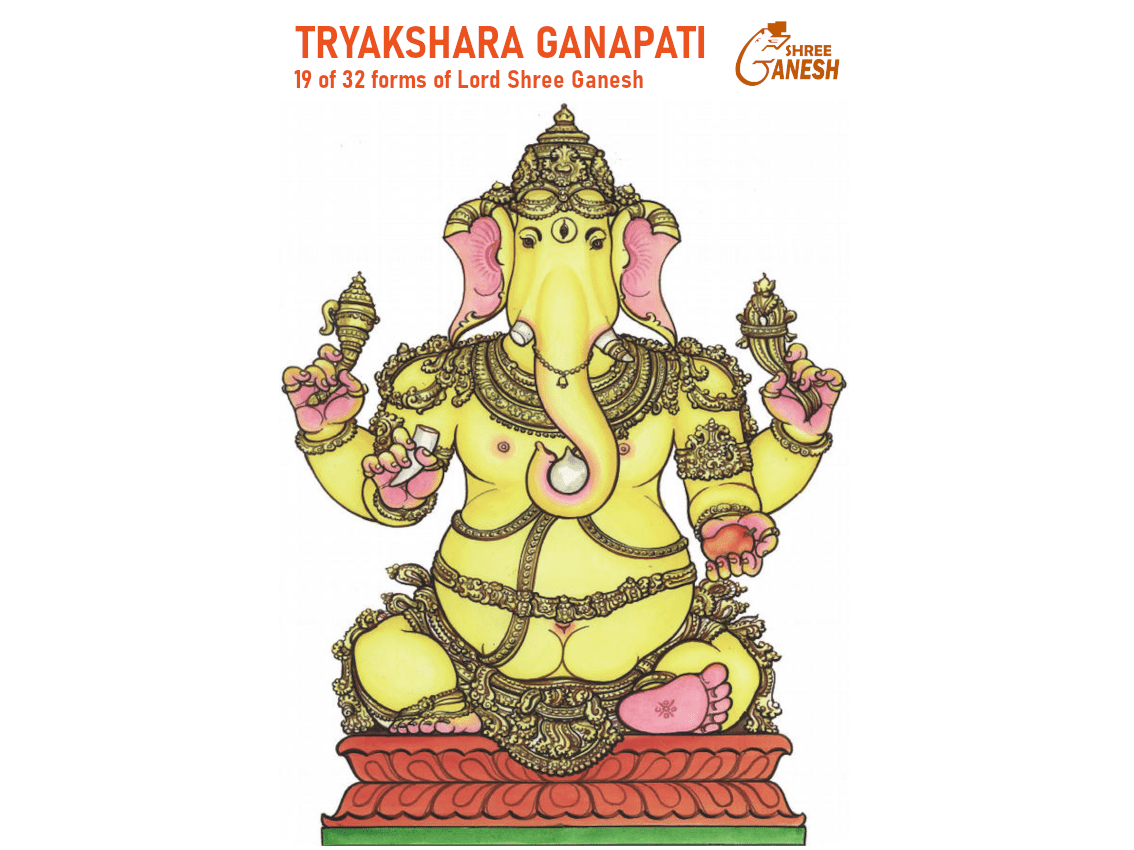
Tryakshara Ganapati (त्र्यक्षर गणपति) is the 19th of the 32 forms of Lord Ganesha. Tryakshara Ganapati, “the Lord of Three Letters,” A-U-M, is gold in colour, and his big floppy ears move like fly whisks. He carries the broken tusk, the goad, the noose and a mango, and is often seen holding a sweet modaka in his trunk.
His name comes from tri, three, and akṣara, syllable or letter. The three letters are A, U and M, which together make Om (ॐ), the sacred sound from which, in Hindu thought, all other sounds and all of creation come.
The 32 forms are listed in the Mudgala Purana, and their meditation verses and paintings are preserved in the Sritattvanidhi, a nineteenth-century treatise from the court of Mysore.
The Form of Tryakshara Ganapati
Golden
His meditation verse calls him hemavarṇa, “the colour of gold.” Gold is the colour of light and of what is precious and lasting.
Ears like fly whisks
The verse begins with his face, “the face of the king of elephants,” and then his ears: calat-karṇa-sucāmara, “whose moving ears are fine fly whisks.” A chamara, a whisk of yak tail, is waved before kings and before deities in temple worship as a mark of honour. Ganesha needs no attendant to wave one: his own great ears fan to and fro. Some descriptions put fly whisks in his ears, but in the verse the ears themselves are the whisks.
The modaka in his trunk
The tip of his trunk, puṣkara, holds a modaka, the sweet dumpling Ganesha loves most. The modaka is often read as the sweetness of the realised inner self, the reward of spiritual life.
Four Hands and What They Hold
- A noose (pasha), which draws the devotee close and holds back what would pull them away.
- A goad (ankusha), which spurs the devotee on, as a mahout guides an elephant.
- His broken tusk (svadanta), in his right hand: the sign of sacrifice, of giving up part of oneself for a higher purpose.
- A mango (amraphala), in his left hand: the ripe fruit of effort, and of knowledge attained.
And in his trunk, a modaka.
The Meditation Verse
The Sritattvanidhi gives this dhyana shloka for Tryakshara Ganapati:
गजेन्द्रवदनं साक्षाच्चलत्कर्णसुचामरम् ।
हेमवर्णं चतुर्बाहुं पाशाङ्कुशधरं वरम् ॥
स्वदन्तं दक्षिणे हस्ते सव्ये त्वाम्रफलं तथा ।
पुष्करैर्मोदकं चैव धारयन्तमनुस्मरेत् ॥
gajendra-vadanaṃ sākṣāc calat-karṇa-sucāmaram / hemavarṇaṃ caturbāhuṃ pāśāṅkuśa-dharaṃ varam / svadantaṃ dakṣiṇe haste savye tv āmraphalaṃ tathā / puṣkarair modakaṃ caiva dhārayantam anusmaret
In English: “One should keep in mind the excellent Lord, with the very face of the king of elephants, whose moving ears are fine fly whisks; golden, four-armed, holding the noose and goad, his own tusk in his right hand and a mango in his left, and a modaka in the tip of his trunk.”
Ganesha and Om
The verse itself does not mention Om, but the name does, and the link between Ganesha and Om runs deep in Hindu tradition.
Om is said to have three parts, A, U and M, and many meanings are given to them: the three states of waking, dreaming and deep sleep; the three gods Brahma, Vishnu and Shiva, who create, preserve and dissolve; and the three worlds. The silence after the sound is the fourth, beyond all three.
Devotees have long seen the shape of ॐ in Ganesha’s own form: the curve of the head and the sweep of the trunk. The Ganapati Atharvashirsha, the best-known Upanishad of Ganesha, says to him tvaṃ brahmā tvaṃ viṣṇus tvaṃ rudraḥ, “you are Brahma, you are Vishnu, you are Rudra,” and closes that praise with Om itself. Ganesha is honoured first, before every prayer and every rite, as Om is spoken first before every mantra.
The Significance of Tryakshara Ganapati
Devotees turn to Tryakshara Ganapati for knowledge, and for a mind that can rest in the sound of Om. Where Ekakshara Ganapati is the Lord of the single seed syllable Gam, Tryakshara is the Lord of the three-lettered sound that holds all others. With his tusk he teaches sacrifice, with his mango the fruit of effort, and with his sweet the joy at the end of the path.
The 32 forms, Tryakshara Ganapati among them, are carved in stone at the Srikanteshvara temple in Nanjangud and the Chamarajeshvara temple in Chamarajanagar, both in Karnataka, and in the Pazhavangadi Ganapathy temple in Thiruvananthapuram, Kerala.
Conclusion
Tryakshara Ganapati, golden and four-armed, fans his great ears like royal whisks and holds a modaka in his trunk. With noose and goad, tusk and mango, he guides his devotees towards the sound A-U-M, and in it towards himself.
Frequently asked questions
- Who is Tryakshara Ganapati?
Tryakshara Ganapati (त्र्यक्षर गणपति) is the 19th of the 32 forms of Lord Ganesha, “the Lord of Three Letters,” golden in colour, with ears that sway like fly whisks.
- What does Tryakshara mean?
Tryakshara means “three syllables,” from tri, three, and akshara, syllable. The three are A, U and M, which together make the sacred sound Om.
- What does Tryakshara Ganapati hold?
A noose and a goad, his broken tusk in his right hand and a mango in his left, and a modaka sweet in the tip of his trunk.
- What are the fly whisks in his ears?
His meditation verse says his moving ears are like fine chamaras, the fly whisks waved before kings and deities; the ears themselves are the whisks.
- How is Ganesha connected with Om?
Hindu tradition sees Om in the shape of Ganesha’s head and trunk, and the Ganapati Atharvashirsha names Ganesha as Om itself.
- Why do devotees worship Tryakshara Ganapati?
They turn to him for knowledge and for a mind that rests in the sound of Om, the source of all mantras.
Continue reading
About Lord Ganesha →
About Lord Ganesha
Pray to Lord Ganesha Online
About Lord Ganesha
Sankatahara Ganapati: The Dispeller of Sorrow
About Lord Ganesha