
Shakti Ganapati: The Powerful Household Guardian
On this page
Introduction
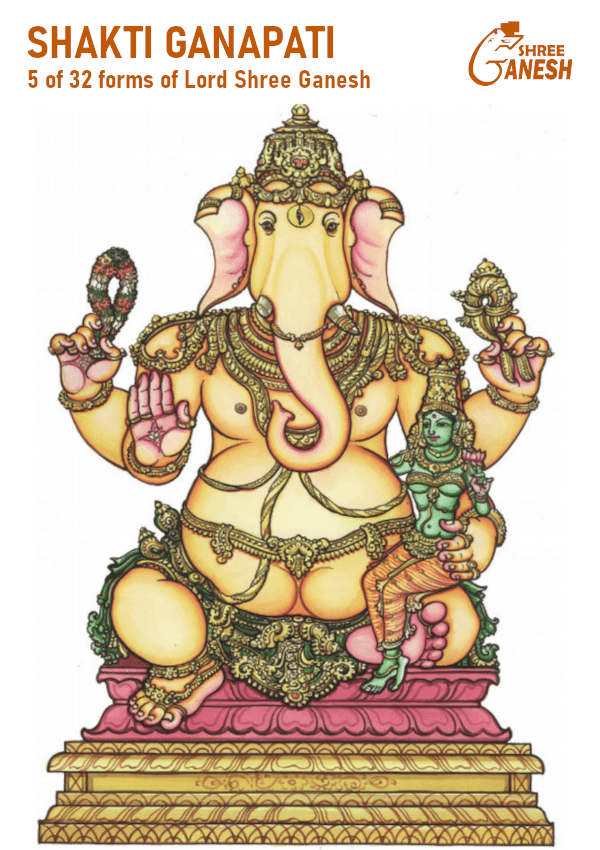
Shakti Ganapati (शक्ति गणपति) is the fifth of the 32 forms of Lord Ganesha. Four-armed and seated with one of his shaktis on his knee, Shakti Ganapati, “the Powerful,” of orange-red hue, guards the householder. He holds a noose and goad and blesses with the abhaya mudra, the gesture that takes away fear.
Shakti means power or energy, and also the goddess who is that power. In Hindu thought every god has his shakti, his active power, pictured as a goddess at his side. Shakti Ganapati is Ganesha together with his shakti: the god and his power as one.
The 32 forms are listed in the Mudgala Purana, and their meditation verses and paintings are preserved in the Sritattvanidhi, a nineteenth-century treatise from the court of Mysore.
The Form of Shakti Ganapati
With the goddess
Shakti Ganapati is seated with the goddess on his knee, close beside him, and one of his arms is around her. His meditation verse describes her as slender and green-hued, and says that their waists are pressed against each other. The verse does not name her. In Hindu tradition Ganesha’s consorts are Siddhi, success, and Buddhi, wisdom, whose wedding to him is told in Lord Ganesha’s Wedding with Siddhi and Buddhi, and other forms among the 32, such as Lakshmi Ganapati and Ucchishta Ganapati, are also shown with a goddess.
Red as the evening sky
His meditation verse calls him sandhyāruṇa, red as the sky at twilight, which is why he is described as orange-red. Twilight, sandhya, is the meeting of day and night, a sacred time of prayer, and a fitting colour for a form that shows the meeting of god and goddess.
Four Arms and What They Hold
- The noose (pasha), which draws devotees close and binds the forces that would harm them.
- The goad (ankusha), which guides the devotee and keeps desires and emotions under control.
- The gesture of fearlessness (abhaya mudra), with one hand raised and open, saying “do not fear.” The verse calls him bhayāpaha, “the one who takes away fear.”
- The embrace, with the fourth arm around the goddess at his side.
The meditation verse names only the noose and the goad, with the embrace and the removal of fear. The popular description of the 32 forms adds a garland. One description of the Mysore painting has him holding a lemon in the hand that embraces the goddess and a sweet in his trunk. These details vary from source to source; the noose, the goad, the fearless hand and the goddess are the heart of the form.
The Meditation Verse
The Sritattvanidhi gives this dhyana shloka for Shakti Ganapati:
आलिङ्ग्य देवीं हरिताङ्गयष्टिं
परस्पराश्लिष्टकटिप्रदेशम् ।
सन्ध्यारुणं पाशसृणी वहन्तं
भयापहं शक्तिगणेशमीडे ॥
āliṅgya devīṃ haritāṅga-yaṣṭiṃ / parasparāśliṣṭa-kaṭi-pradeśam / sandhyāruṇaṃ pāśa-sṛṇī vahantaṃ / bhayāpahaṃ śakti-gaṇeśam īḍe
In English: “I praise Shakti Ganesha, red as the evening sky, who embraces the goddess of slender, green-hued body, the two of them close together at the waist; who carries the noose and the goad, and takes away fear.”
A Form of Inner Worship
Shakti Ganapati belongs to the forms of Ganesha that are worshipped in the Tantric tradition. The scholar S. K. Ramachandra Rao, writing on the Sritattvanidhi paintings, counts him with Ucchishta Ganapati and Lakshmi Ganapati among the Tantric forms, whose worship is esoteric and kept within particular traditions. In this worship the union of Ganesha and his shakti stands for the union of consciousness and energy, the two that together make the world.
The Significance of Shakti Ganapati
For most devotees, Shakti Ganapati is the guardian of the home. Seated with his consort, he is the form of Ganesha closest to family life, and householders turn to him to protect their homes, keep harmony between husband and wife, and keep fear away from the family. His noose and goad hold back harm and guide the household on the right path; his raised hand says that, with him present, there is nothing to fear.
He is one of the first sixteen forms, the Shodasha Ganapati. As Loving Ganesha records, these sixteen are installed in an eight-sided, chariot-shaped shrine at the Shri Shankara Mandapam in Rameshvaram, South India, established by Shri Chandrasekharendra Saraswati, the 68th head of the Kanchi Kamakoti Pitham.
The 32 forms, Shakti Ganapati among them, are carved in stone at the Srikanteshvara temple in Nanjangud and the Chamarajeshvara temple in Chamarajanagar, both in Karnataka, and in the Pazhavangadi Ganapathy temple in Thiruvananthapuram, Kerala.
Conclusion
Shakti Ganapati, the Powerful, glows red as the evening sky, the goddess held close at his side. With noose and goad he protects and guides; with his open hand he takes away fear. He is Ganesha united with his power, and the guardian of every household that calls on him.
Frequently asked questions
- Who is Shakti Ganapati?
Shakti Ganapati (शक्ति गणपति) is the fifth of the 32 forms of Lord Ganesha, “the Powerful,” a four-armed, orange-red Ganesha seated with one of his shaktis, who guards the householder.
- What does Shakti mean?
Shakti means power or energy, and also the goddess who is that power. Shakti Ganapati is Ganesha united with his shakti.
- What does Shakti Ganapati hold?
His meditation verse names a noose and a goad, and calls him the remover of fear; one hand gives the abhaya mudra and one arm embraces the goddess.
- Who is the goddess with Shakti Ganapati?
The verse does not name her. It describes a goddess of slender, green-hued body, seated close against him, their waists touching.
- Why is Shakti Ganapati called the guardian of householders?
Seated with his consort, he is the form of Ganesha closest to family life, and householders turn to him to protect the home and keep harmony in it.
- What colour is Shakti Ganapati?
Orange-red. His meditation verse calls him sandhyāruṇa, red as the evening sky at twilight.
Continue reading
About Lord Ganesha →
About Lord Ganesha
Pray to Lord Ganesha Online
About Lord Ganesha
Sankatahara Ganapati: The Dispeller of Sorrow
About Lord Ganesha