
Urdhva Ganapati: The Elevated Lord in Golden Splendor
On this page
Introduction
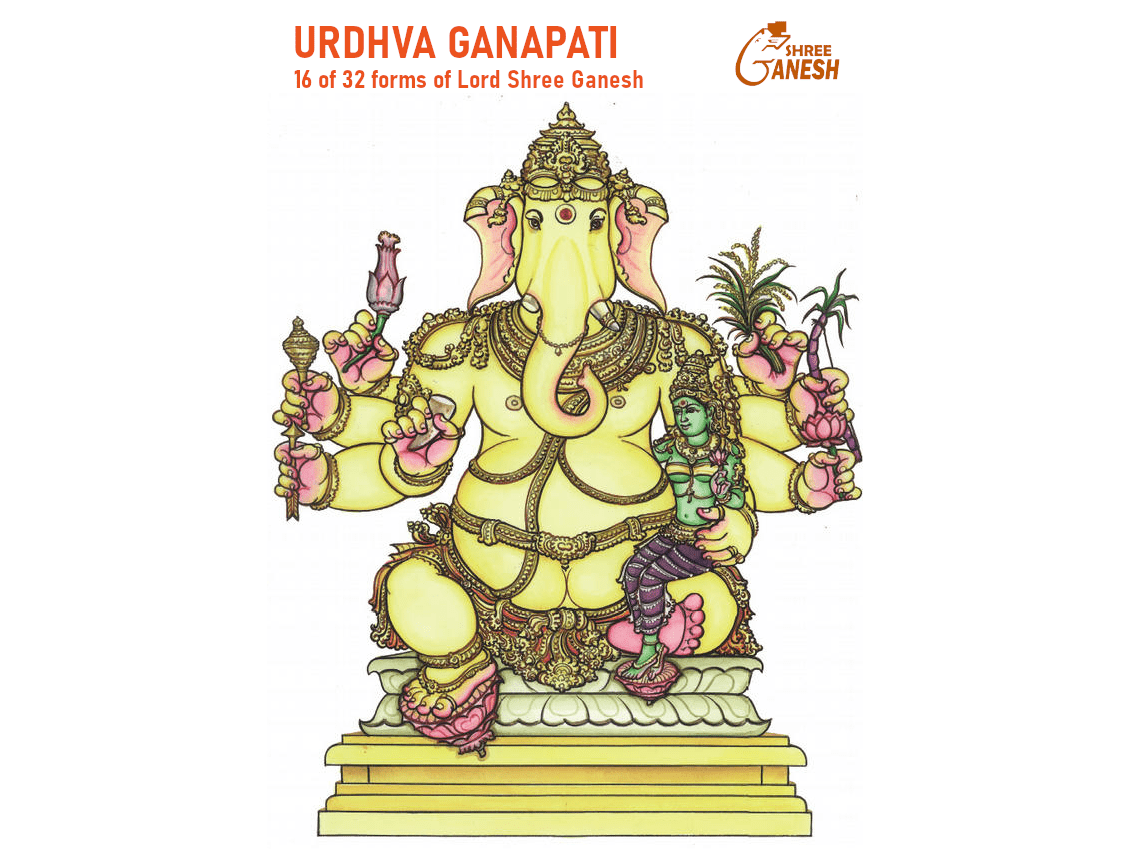
Urdhva Ganapati (ऊर्ध्व गणपति) is the 16th of the 32 forms of Lord Ganesha. Seated with one of his Shaktis on his left knee, Urdhva Ganapati is “the Elevated” Lord of golden hue. In his hands he holds a sprig of paddy, a lotus, the sugarcane bow, an arrow, his ivory tusk, a water lily and a mace.
Ūrdhva is Sanskrit for “raised,” “upright” or “upward.” It is the direction of growth: of the plant rising from the soil, and of the mind rising from the ordinary to the higher. Some translators call him the Upright Ganapati, others the Elevated.
The 32 forms are listed in the Mudgala Purana, and their meditation verses and paintings are preserved in the Sritattvanidhi, a nineteenth-century treatise from the court of Mysore.
The Form of Urdhva Ganapati
Golden and shining
His meditation verse calls him kanakojjvalāṅga, “whose body blazes like gold.” Gold is the colour of wealth and of light, and in this form it goes with the harvest he carries: ripe paddy and sugarcane, the riches that come from the earth.
The Shakti on his knee
Urdhva Ganapati is one of the forms of Ganesha who sit with a goddess, his Shakti, the divine power that acts through him. She sits on his left knee, and he holds her in one arm. The verse calls her haritāṅgayaṣṭi, “whose slender body is green,” and the Mysore painting shows her so, green against his gold. In Hindu thought the god and his Shakti are never two separate beings: he is the stillness and she the power that moves, and together they make the whole. Other forms that sit with a Shakti include Shakti Ganapati and Varada Ganapati.
Seated in ease
He sits with one leg folded and the other resting down, a relaxed royal posture. His elevation is not the stiffness of someone standing to attention, but the ease of one who has already risen.
Eight Arms and What They Hold
The verse lists seven things in his hands, and an eighth arm “raised to embrace” the goddess. In the order of the verse:
- A water lily (kalhara), the lily of temple tanks, for beauty and the opening of the heart.
- A sheaf of paddy (shali), rice in the ear, the staple food of South India and a sign that his devotees will not go hungry.
- A lotus (kamala), which rises clean out of muddy water: the sign of purity and of spiritual unfolding.
- A sugarcane bow (ikshu-chapa), the sweet bow carried by Kama, god of love, and by the goddess Lalita. In Ganesha’s hands it shows desire brought under control and turned to good.
- An arrow (bana), for aim and focus.
- His tusk (danta), the broken tusk, the sign of sacrifice.
- A mace (gada), for strength and protection.
- The embrace, his eighth arm drawn around his Shakti.
Sources count his arms differently. Loving Ganesha gives six hands and leaves out the mace. The art historian T. A. Gopinatha Rao, reading the verse itself, counts eight arms, and the painting of this form shows eight, one of them holding the mace.
The Meditation Verse
The Sritattvanidhi gives this dhyana shloka for Urdhva Ganapati:
कल्हारशालिकमलेक्षुकचापबाण-
दन्तप्ररोहकगदी कनकोज्ज्वलाङ्गः ।
आलिङ्गनोद्यतकरो हरिताङ्गयष्ट्या
देव्या करोतु शुभमूर्ध्वगणाधिपो मे ॥
kalhāra-śāli-kamalekṣuka-cāpa-bāṇa- / danta-prarohaka-gadī kanakojjvalāṅgaḥ / āliṅganodyata-karo haritāṅga-yaṣṭyā / devyā karotu śubham ūrdhva-gaṇādhipo me
In English: “Holding a water lily, paddy, a lotus, a sugarcane bow, an arrow, his tusk and a mace, his body shining like gold, his hand raised to embrace the goddess whose slender body is green: may Urdhva, Lord of the ganas, bring me good fortune.”
Some versions end with diśatv abhayam, “may he grant fearlessness,” in place of karotu śubham, “may he bring good fortune.”
The Significance of Urdhva Ganapati
The verse asks one thing of him: śubham, what is good and auspicious. Devotees turn to Urdhva Ganapati for a home that has enough, and for the strength to rise above their present state, in the world and within. His paddy and sugarcane speak of plenty; his lotus and water lily of beauty and purity; his bow and arrow of desire given a clear aim. Seated with his Shakti, he shows that this rising is not a flight from life but the whole of life, held in balance.
He is one of the first sixteen forms, the Shodasha Ganapati. As Loving Ganesha records, these sixteen are installed in an eight-sided, chariot-shaped shrine at the Shri Shankara Mandapam in Rameshvaram, South India, established by Shri Chandrasekharendra Saraswati, the 68th head of the Kanchi Kamakoti Pitham.
The 32 forms, Urdhva Ganapati among them, are carved in stone at the Srikanteshvara temple in Nanjangud and the Chamarajeshvara temple in Chamarajanagar, both in Karnataka, and in the Pazhavangadi Ganapathy temple in Thiruvananthapuram, Kerala.
Conclusion
Urdhva Ganapati, the Elevated Lord, shines like gold with his green-limbed Shakti on his knee. In his hands are the harvest, the lotus, the sweet bow and its arrow, his tusk and his mace. He is the Lord of rising: of crops from the soil, of a household into plenty, and of the mind towards what is higher.
Frequently asked questions
- Who is Urdhva Ganapati?
Urdhva Ganapati (ऊर्ध्व गणपति) is the 16th of the 32 forms of Lord Ganesha, “the Elevated” Lord of golden hue, seated with one of his Shaktis on his left knee.
- What does Urdhva mean?
Urdhva is Sanskrit for “raised,” “upright” or “upward,” so Urdhva Ganapati is the Elevated or Upright Lord.
- What does Urdhva Ganapati hold?
His meditation verse names a water lily, a sheaf of paddy, a lotus, a sugarcane bow, an arrow, his tusk and a mace, while one arm embraces the goddess.
- Who is the goddess on his knee?
She is his Shakti, his divine power in female form. The verse describes her as green, slender as a stalk, and held in his embrace.
- How many arms does Urdhva Ganapati have?
The verse lists seven things held and an eighth arm that embraces the goddess, so it is counted as eight arms; Loving Ganesha gives six hands and leaves out the mace.
- Why do devotees worship Urdhva Ganapati?
His verse asks him to bring auspiciousness, and devotees turn to him for plenty in the home and for the strength to rise above their present state.
Continue reading
About Lord Ganesha →
About Lord Ganesha
Pray to Lord Ganesha Online
About Lord Ganesha
Sankatahara Ganapati: The Dispeller of Sorrow
About Lord Ganesha