
Varada Ganapati: The Boon-Giver
On this page
Introduction
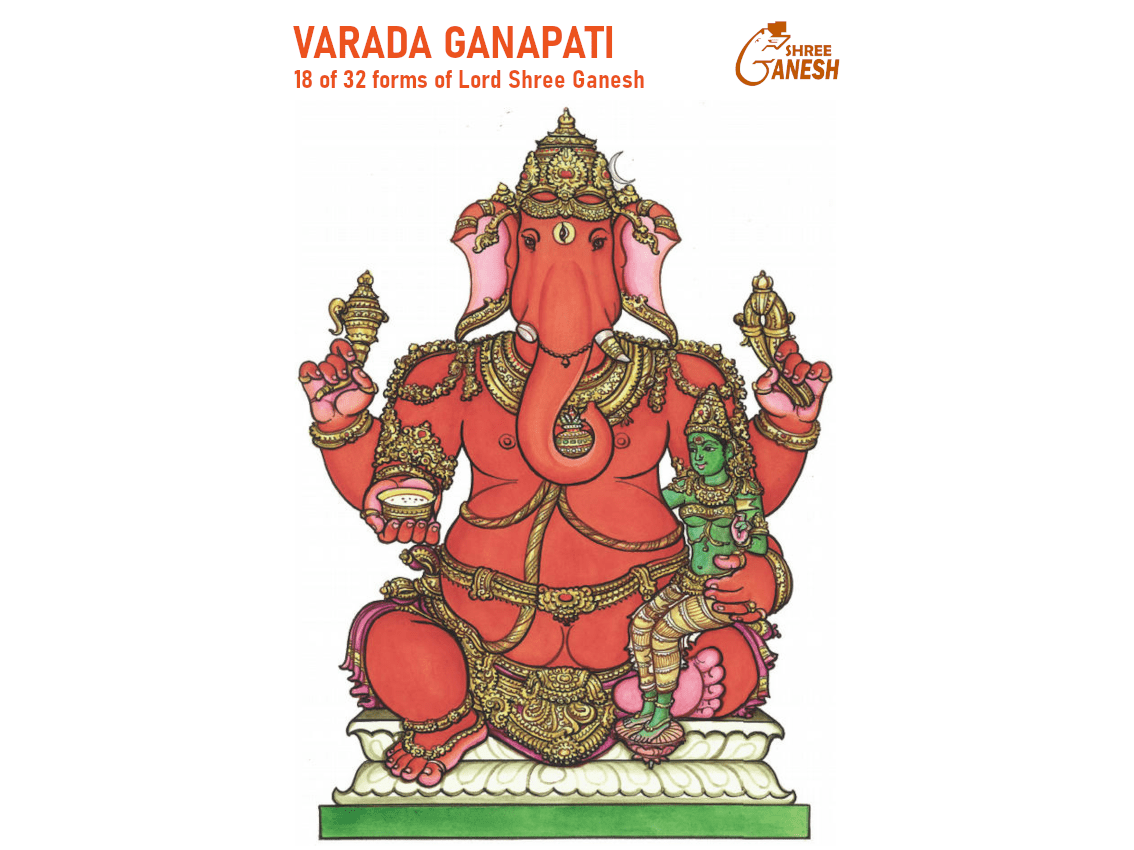
Varada Ganapati (वरद गणपति) is the 18th of the 32 forms of Lord Ganesha. Varada Ganapati, “the Boon-Giver,” has a prominent third eye of wisdom. He holds a dish of honey, the noose and the goad, and encloses a pot of jewels in his trunk. His Shakti is at his side, and the crescent moon adorns his crown.
Varada means “giver of boons,” from vara, a boon or a wish granted, and da, giving. The Sritattvanidhi names this form simply Vara Ganapati, the Lord of Boons; many modern lists, following the Himalayan Academy, call him Varada.
The 32 forms are listed in the Mudgala Purana, and their meditation verses and paintings are preserved in the Sritattvanidhi, a nineteenth-century treatise from the court of Mysore.
The Form of Varada Ganapati
Red as vermilion
His meditation verse calls him sindūrābha, “shining like vermilion.” Sindur, the red-orange powder smeared on Ganesha’s images in temples across India, is his colour here. It is the colour of energy and of good fortune.
The third eye and the crescent moon
He is trinayana, three-eyed, and the Mysore painting draws the third eye large and clear on his forehead. It is the eye of wisdom that sees beyond what the two eyes see. The crescent moon, indu, rests on his crown. Both marks come from his father, Shiva.
Pushti, his Shakti
Like Urdhva Ganapati and Shakti Ganapati, Varada Ganapati sits with a goddess, his Shakti. Here the verse names her: Pushti, “nourishment” or “growth.” She embraces him, holding a banner in one hand and a lotus in the other, and his fourth hand rests upon her. The painting shows her small and green-limbed, seated on his left knee. A boon is something that makes life grow and flourish, and Pushti is that growth in the form of a goddess. As Loving Ganesha explains of Ganesha’s shaktis, they are not separate consorts but aspects of his own being, his power, and they stand for the blessings his worshippers receive.
Four Hands and What They Hold
- A noose (pasha), which draws the devotee close and holds back what would pull them away.
- A goad (ankusha), which spurs the devotee on, as a mahout guides an elephant.
- A dish of honey (madhu), brimming with the sweetness of life and of devotion.
- The fourth hand, resting on his Shakti, Pushti.
- A pot of riches (vasumat-patra), not in a hand but held in the curl of his trunk, the treasury from which his boons are given.
The Meditation Verse
The Sritattvanidhi gives this dhyana shloka for Vara Ganapati:
सिन्दूराभमिभाननं त्रिनयनं हस्ते च पाशाङ्कुशौ
बिभ्राणं मधुमत्कपालमनिशं साध्विन्दुमौलिं भजे ।
पुष्ट्याश्लिष्टतनुं ध्वजाग्रकरया पद्मोल्लसद्धस्तया
तद्योन्याहितपाणिमात्तवसुमत्पात्रोल्लसत्पुष्करम् ॥
sindūrābham ibhānanaṃ trinayanaṃ haste ca pāśāṅkuśau / bibhrāṇaṃ madhumat-kapālam aniśaṃ sādhv-indumauliṃ bhaje / puṣṭyāśliṣṭa-tanuṃ dhvajāgra-karayā padmollasad-dhastayā / tad-yony-āhita-pāṇim ātta-vasumat-pātrollasat-puṣkaram
In English: “I worship the elephant-faced Lord, red as vermilion and three-eyed, who holds in his hands a noose and a goad, and always a dish full of honey, with the fair crescent moon on his crown. His body is embraced by Pushti, who holds a banner in one hand and a shining lotus in the other; his own hand rests upon her, and the tip of his trunk holds a gleaming pot of riches.”
Varadvinayak of Mahad
The name Varada Vinayaka, the boon-giving Ganesha, is best known in Maharashtra, where Shree Varadvinayak of Mahad is one of the eight Ashtavinayaka shrines. The temple has its own image, seated with his trunk turned to the left, and its own legend. The sage Gritsamada did penance to Ganesha in the forest there, and when Ganesha appeared and offered him a boon, Gritsamada asked that he stay in that place and bless all who came to him. Ganesha agreed, and so is worshipped there as Varada, the giver of boons. The image at Mahad is not the 18th form of the Sritattvanidhi, but both carry the same promise.
The Significance of Varada Ganapati
Every form of Ganesha grants wishes, but Varada Ganapati is the one named for it. Devotees turn to him for the fulfilment of their prayers and for a life that grows in every way: in health, family, wealth and wisdom. His pot of riches is the store of his blessings, his honey their sweetness, and Pushti beside him the growth they bring. His third eye is a reminder that the best boon of all is the wisdom to see what truly helps.
The 32 forms, Varada Ganapati among them, are carved in stone at the Srikanteshvara temple in Nanjangud and the Chamarajeshvara temple in Chamarajanagar, both in Karnataka, and in the Pazhavangadi Ganapathy temple in Thiruvananthapuram, Kerala.
Conclusion
Varada Ganapati, the Boon-Giver, is red as vermilion, three-eyed and crowned with the moon. With noose and goad he guides, with his dish of honey he offers sweetness, and with Pushti in his embrace and a pot of riches in his trunk he gives the boons that make life flourish.
Frequently asked questions
- Who is Varada Ganapati?
Varada Ganapati (वरद गणपति) is the 18th of the 32 forms of Lord Ganesha, “the Boon-Giver,” red as vermilion, with a prominent third eye of wisdom and his Shakti at his side.
- What does Varada mean?
Varada means “giver of boons,” from vara, a boon or a wish granted, and da, giving. The Sritattvanidhi calls this form Vara Ganapati.
- What does Varada Ganapati hold?
A noose, a goad and a dish of honey in three hands, while his fourth hand rests on his Shakti; his trunk holds a pot of riches.
- Who is the goddess beside Varada Ganapati?
His Shakti, named Pushti in the meditation verse. She embraces him and holds a banner and a lotus.
- What does the dish of honey mean?
It is brimming with the sweetness of life and of devotion.
- Is Varada Ganapati the same as Varadvinayak of Mahad?
They share the name, the boon-giving Lord, but the Ashtavinayaka temple at Mahad has its own image and legend, of the sage Gritsamada.
Continue reading
About Lord Ganesha →
About Lord Ganesha
Pray to Lord Ganesha Online
About Lord Ganesha
Sankatahara Ganapati: The Dispeller of Sorrow
About Lord Ganesha